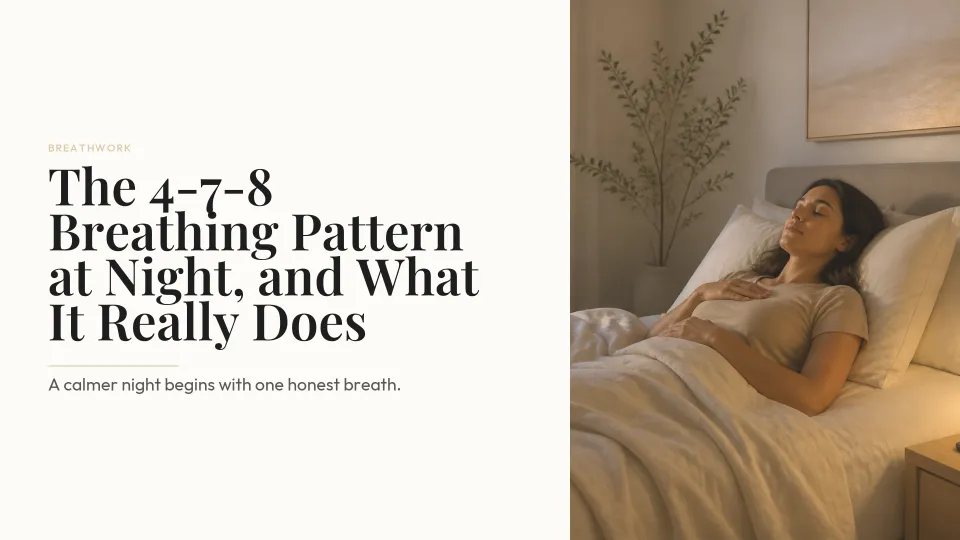
It is 11.20pm, the light is off, and your head is running through tomorrow in the order you least want. The email you did not answer. The meeting that needs you sharp. The child’s school message, the train time, the thing you said at dinner, the small ache in your shoulder, the larger feeling that you should be sleeping already.
You are not looking for a miracle. You are looking for something simple to do in the dark that does not involve another screen, another productivity trick, or another reason to feel behind.
That is where 4-7-8 breathing for sleep often appears. It is shared as a night technique, a calming count, a way to give your mind something steady when the day has not fully left your body. The honest version is more useful than the exaggerated one: 4-7-8 breathing for sleep is a comfort practice, not a treatment. It is not proven to make you fall asleep. It has no large randomised trial behind this specific pattern. Still, breathing before bed with a slower exhale can be a reasonable, low effort practice to try because it costs nothing, takes minutes, and asks very little of you.
The pattern, step by step
The 4-7-8 pattern is simple in theory: inhale for four, hold for seven, exhale for eight. At night, the aim is not performance. You are not trying to “win” the breath or complete perfect rounds. You are creating a slow, repeatable rhythm that gives your attention somewhere gentle to rest.
Start sitting on the edge of the bed, lying on your back, or lying on your side. Choose the position that feels easiest for your body at 11pm. Keep your shoulders soft. Let your jaw loosen. If you are in bed, allow the mattress to hold you rather than bracing yourself into a posture.
- Inhale quietly through the nose for four counts.
- Hold the breath for seven counts.
- Exhale slowly through a soft mouth for eight counts.
- Pause naturally, then begin again if it feels comfortable.
A soft mouth means the lips are relaxed, not forced. The exhale can be a gentle stream of air, almost like cooling soup, but without tension. If nasal breathing is uncomfortable, do not make the practice into a struggle. Comfort matters more than purity.
Try two to four rounds at first. That is enough to understand how the pattern feels. The hold is the part people most often find difficult. If seven counts feels too long, shorten it. You might try inhale for four, hold for three, exhale for six. You are still practising slow breathing at night, and the counts can be approximate.
Never practise while driving or doing anything that requires attention. This is a sitting or lying practice only.
What the evidence actually says
The honest evidence for 4-7-8 breathing for sleep is thinner than its popularity suggests. There is no large randomised controlled trial on the 4-7-8 technique specifically. That does not make it useless, but it does mean it should not be presented as a proven sleep treatment.
Evidence on deep breathing techniques in clinical practice is often described as limited, mixed, or of low quality. Much of the public support for these practices is anecdotal: people try a breathing pattern, feel calmer, and share it. Personal experience can be meaningful, especially for a low risk evening ritual, but it is not the same as strong clinical proof.
Small studies on breathing practices have reported pre and post improvements on measures such as heart rate and blood pressure in small samples of healthy young adults. These findings are interesting, but they are not the same as showing that 4-7-8 breathing for sleep treats insomnia, anxiety, or chronic stress. They also may not apply to a 42-year-old consultant in Berlin, a parent in London, or a business owner in Barcelona lying awake after a demanding day.
So the best way to frame the practice is plain and respectful: breathing before bed may help some people feel steadier. It may make the transition into rest feel less abrupt. It is worth trying because it is simple, free, and easy to stop. It should not replace sleep care, medical care, or psychological support when those are needed.
This is the same grounded approach behind One Body Now: simple actions, less overwhelm, and no need to turn wellness into another complicated project.
Why a longer exhale still feels calming
Even without making strong medical claims, there is a practical reason the pattern appeals to tired adults: it slows the moment down. A longer exhale than inhale is one of the simplest forms of slow breathing to sustain. You do not need a timer, equipment, music, or a perfect environment. You only need a count and a willingness to soften the pace.
People often report that slow breathing at night gives the mind a task that is not demanding. Counting four, seven, and eight is just enough structure to interrupt the mental loop, but not so much that it wakes you up further. When your head is replaying tomorrow’s schedule, the count can become a quiet handrail.
The longer exhale also tends to feel emotionally different from a sharp sigh or shallow breathing. It is slower. It is less reactive. It gives you time to notice whether you are gripping the sheets, lifting your shoulders, clenching your jaw, or holding your stomach tight. None of this requires analysis. It is simply a shift from “think harder” to “do something softer.”
For some people, 4-7-8 breathing for sleep feels too structured. If that is you, the useful part may not be the exact numbers. It may be the basic shape: a manageable inhale, a pause if comfortable, and an exhale that lasts longer than the inhale. That slower rhythm is often enough for an evening breathing practice.
Think of it as a comfort ritual. Like dimming a lamp or turning your phone face down, it does not force sleep. It simply makes the room inside you a little quieter.
Where it fits in an evening
4-7-8 breathing for sleep works best when you treat it as one small part of an evening, not as a last-minute rescue mission you must get “right.” It can fit after the screens are away, once you are already in bed, or during a night waking when you want something calm to return to.
If possible, give yourself a short buffer before bed. That might be five minutes without email, a warm shower, dimmer lighting, or a few pages of a paper book. Then try two rounds of breathing. The practice does not need a candle, a special cushion, or a perfect routine. It needs enough quiet for you to feel the count.
During a night waking, keep it even simpler. Avoid checking the time if you can. Stay lying down. Try one round with approximate counts. If the seven-count hold makes you more alert or uneasy, remove it and use a slower exhale instead. For example, inhale for three and exhale for five or six.
You can also pair an evening breathing practice with a small body cue: unclench your hands, let your tongue rest, soften your forehead, or feel your back against the bed. These cues are not magic. They simply bring your attention out of tomorrow and back into the room.
The counts matter less than the slowing. If four, seven, and eight feel smooth, use them. If they feel like a test, adjust them. Breathing to wind down should feel like support, not another task on your list.
For more gentle practices around recovery and rest, the Breathwork section of The Journal offers simple ideas designed for busy lives.
When to stop, and when to ask
Stop the practice if you feel dizzy, short of breath, light-headed, or uneasy during the hold. The hold is the part people find hardest, and there is no prize for pushing through discomfort. If your body says no, listen. You can return to normal breathing, open your eyes, sit up, or switch to a shorter pattern.
It is also worth remembering that 4-7-8 breathing for sleep is not a replacement for sleep, medical care, or psychological support. It is a comfort practice. That distinction protects you from blaming yourself if it does not change your night. If you have been awake for weeks, feel anxious about bed, or dread the evening because sleep has become a battle, you deserve more support than a counting technique.
Ask a professional if you have persistent insomnia, a breathing condition, a heart condition, pregnancy, or anxiety that worsens when you focus on the breath. Some people find breath holds unsettling. Others feel more aware of symptoms when they lie still. That does not mean you have failed. It means your body may need a different approach.
For people who do like structure, the safest version is flexible. Practise sitting or lying only. Keep the rounds low. Make the counts approximate. Stop early if needed. Never use the practice while driving. Avoid turning it into a challenge, especially late at night when your system is already tired.
If you want a broader routine, combine breathing before bed with simple movement and realistic nutrition rather than relying on one technique. One Body Now brings movement, meals, and breath into one calmer system, including practices like One Rep Now for short movement and One Meal Now for simple food awareness.
Frequently Asked Questions
Is 4-7-8 breathing for sleep proven to work?
No large randomised controlled trial exists on the 4-7-8 technique specifically, so it should not be described as proven to make you sleep. The broader evidence on deep breathing techniques is often small, mixed, or low quality, with much public support coming from personal experience. It may still be worth trying as a comfort practice because it is simple, free, and easy to stop.
How many rounds should I do before bed?
Start with two to four rounds. That is enough for most people to feel whether the pattern is comfortable. If the breath hold feels long, shorten it or remove it. The goal is not to complete a perfect set. The goal is to create a slower rhythm that helps you wind down without pressure, strain, or a sense of performance.
What if the seven-count hold makes me uncomfortable?
Stop the pattern and return to normal breathing. The hold is the part people most often find difficult. You can try a gentler version, such as inhaling for four and exhaling for six, with no hold at all. If breath holds create dizziness, breathlessness, or anxiety, do not force them. A comfortable longer exhale is enough for an evening breathing practice.
Can I use 4-7-8 breathing during a night waking?
Yes, if it feels comfortable. Keep it very simple. Stay lying down, avoid checking the time if possible, and try one or two approximate rounds. If counting makes you more alert, switch to a softer rhythm, such as a quiet inhale and a longer easy exhale. The practice is there to support rest, not to become another thing to monitor.
Who should ask a professional before trying it?
Ask a professional if you have persistent insomnia, a breathing condition, a heart condition, pregnancy, or anxiety that worsens when you focus on breathing. You should also stop if you feel dizzy, short of breath, or uneasy. 4-7-8 breathing is not medical care, sleep treatment, or psychological support. It is a simple comfort practice that may suit some people and not others.
One Breath Now is there if you want calm, guided breathing that fits into real evenings without making rest feel complicated.
Try one round tonight, and let the count be approximate.
Quotes for: The 4-7-8 Breathing Pattern at Night, and What It Really Does
“It’s a natural tranquilizer for the nervous system.”, Dr. Andrew Weil, on the 4-7-8 breathing exercise
How to use it: This quote is ideal for explaining why 4-7-8 breathing is often used before bed: it may help shift the body away from stress arousal and toward relaxation.
“The relaxation response is the opposite of the stress response.”,
Dr. Herbert Benson, The Relaxation Response
How to use it: This supports the idea that slow, intentional breathing does not “force” sleep, but may create the physiological conditions that make sleep easier.
“Breath is the bridge which connects life to consciousness.”
Thich Nhat Hanh, The Miracle of Mindfulness
How to use it: This quote works well when discussing the mental side of 4-7-8 breathing: counting the breath gives the mind something simple and steady to rest on at night.
“When the breath wanders, the mind is unsteady.”
Hatha Yoga Pradipika
How to use it: This classic yogic idea connects directly to bedtime breathing practices, where regulating the breath can help settle racing thoughts.
“Sleep is the single most effective thing we can do...”
Dr. Matthew Walker, Why We Sleep
How to use it: This quote can introduce the bigger point: 4-7-8 breathing matters because it may support the conditions for better sleep, not because it is a magic sleep switch.
Recommended Books
- Breath: The New Science of a Lost Art by James Nestor
A popular science book exploring how breathing patterns, nasal breathing, and breath control affect health, stress, and performance. Useful for giving readers a broader context for why slow breathing techniques like 4-7-8 may feel calming. - The Relaxation Response by Herbert Benson, M.D., and Miriam Z. Klipper
A foundational book on the body’s ability to counteract stress through simple practices such as breathing, repetition, and quiet focus. Highly relevant for explaining what 4-7-8 breathing “really does” at a nervous-system level. - Why We Sleep by Matthew Walker, Ph.D.
A widely read overview of sleep science, covering why sleep matters for the brain, body, memory, mood, and health. Helpful for framing 4-7-8 breathing as a sleep-support habit rather than a cure for insomnia. - The Sleep Solution: Why Your Sleep Is Broken and How to Fix It by W. Chris Winter, M.D.
A practical guide by a sleep physician that explains common sleep problems in approachable language. Good for readers who want to understand where breathing exercises fit within a larger sleep routine. - The Breathing Book: Good Health and Vitality Through Essential Breath Work by Donna Farhi
A gentle, body-aware guide to breathing mechanics and breath practices. Useful for readers who want to improve their relationship with breathing beyond a single nighttime technique. - The Oxygen Advantage by Patrick McKeown
Focuses on nasal breathing, breath efficiency, and carbon dioxide tolerance. While more performance-oriented, it offers helpful background on why slower, lighter breathing can influence calmness and physical state. - Full Catastrophe Living by Jon Kabat-Zinn, Ph.D.
A major work on mindfulness-based stress reduction, including breath awareness and body-based relaxation. Relevant for explaining how bedtime breathing can reduce mental reactivity and help people unwind.
Key Takeaway for the Blog Post
The 4-7-8 breathing pattern is best understood as a relaxation cue. By inhaling for 4 counts, holding for 7, and exhaling for 8, the practice slows attention, lengthens the exhale, and may encourage parasympathetic nervous system activity. At night, that can help reduce mental and physical arousal , but it should be presented as a supportive sleep habit, not an instant cure for sleep disorders.