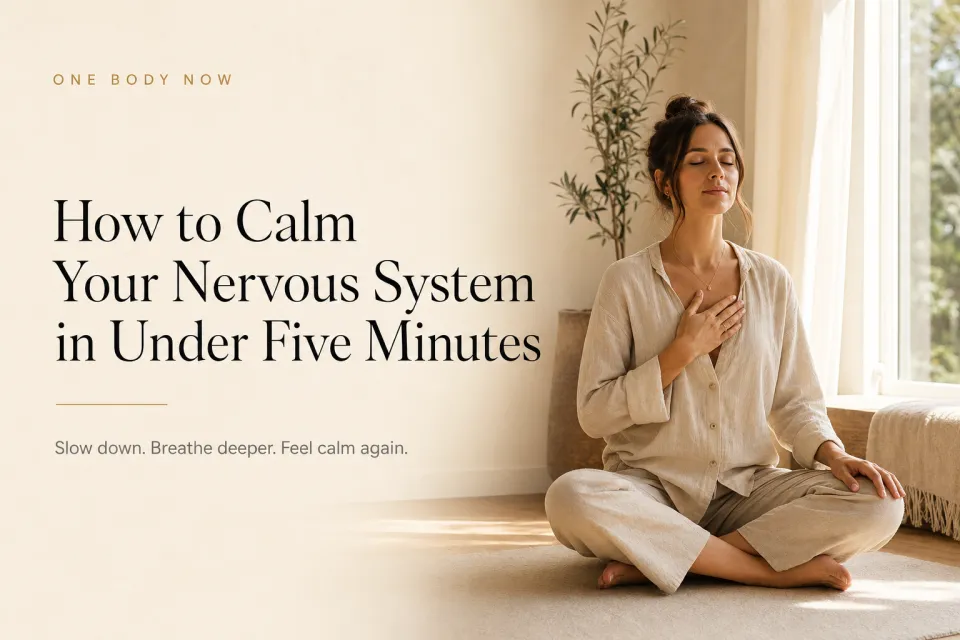
If your body feels tense, your mind is racing, and your phone keeps pulling you back into the noise, calm can feel much further away than it really is. Many people search for how to calm your nervous system because they are not looking for a dramatic life overhaul. They simply want to stop feeling overwhelmed, breathe more easily, and return to themselves for a moment.
The modern working day makes this harder. Notifications arrive before your first deep breath of the morning. Meetings stack on top of each other. Lunch becomes a screen-side pause rather than a real reset. Even when the day ends, the body can remain switched on, as if it has not received the message that it is safe to soften.
Here is the encouraging truth: calming your nervous system does not have to mean disappearing to a retreat, sitting perfectly still for an hour, or becoming someone who never feels stress. Breath is already with you. It is available in the elevator, before a call, after a difficult email, while waiting for coffee, or in bed when your thoughts are moving too quickly.
Breathwork is not a performance. It is a simple signal to the body. A slower exhale, a gentle sigh, or one minute of steady breathing can begin to interrupt stress momentum and invite the body back toward regulation. Not perfectly. Not instantly every time. But often enough to become a trustworthy daily practice.
In this guide, you will learn:
- Why telling yourself to relax rarely works when your body feels wired.
- How breathing exercises for stress can support nervous system regulation in real life.
- Why short practices are often more sustainable than long routines.
- How to use a five minute breathing exercise at work, at home, and before sleep.
- Simple breathing techniques you can use before emails, meetings, notifications, and difficult moments.
- A practical 7-day beginner framework based on one small breath action per day.
Think of this as your quick navigation: first, we will understand why calm cannot be forced. Then we will explore how breath communicates with the body. After that, you will find practical breathwork tools, workplace examples, phone-checking rituals, a 7-day plan, expert strategies, a checklist, and a detailed FAQ.
Why Telling Yourself to Relax Rarely Works
When you feel tense, distracted, or emotionally overloaded, the advice to “just relax” can feel almost impossible to follow. You may understand the idea intellectually, but the body often has its own rhythm. This is why learning how to calm your nervous system starts with respecting the body rather than arguing with it.
Stress is not only a thought pattern. It is also a physical state. Your breathing changes, your muscles tighten, your attention narrows, and your reactions can become quicker. You may notice shallow breathing, a clenched jaw, a tight chest, or the sense that you are moving through the day slightly ahead of yourself.
The body needs a signal, not a command
When the nervous system is activated, calm thoughts alone may not be enough. You can tell yourself, “I am fine,” while your breath remains short and your shoulders stay lifted. The body is not being difficult. It is simply responding to signals.
Breath is one of the most accessible signals you can send. Unlike your heart rate or digestion, breathing sits in an unusual place: it happens automatically, but you can also consciously influence it. That means breath becomes a bridge between the body’s automatic stress response and your intentional choice to slow down.
Calm often begins when the body receives a different signal. One slow exhale can say, “There is space now.”
Why relaxation can feel inaccessible
Many people abandon calming practices because they expect relaxation to arrive immediately. They try to breathe deeply once, do not feel transformed, and assume it is not working. But nervous system regulation is usually less dramatic and more practical than that.
It can look like:
- Responding to a message with more patience.
- Pausing before speaking in a difficult meeting.
- Feeling slightly more present after a long exhale.
- Letting the jaw soften before sleep.
- Noticing tension before it becomes overwhelm.
These moments may seem small, but they matter. Calm is not always a wave of peace. Sometimes it is simply a little more room between stimulus and response.
A real-world example: the meeting before the meeting
Imagine Sophie, a People and Culture Director preparing for a leadership meeting. She has just come out of a tense call, her inbox is full, and she has two minutes before presenting engagement survey results. Telling herself to relax may not work. But placing one hand on her chest, breathing in gently, and taking a longer exhale gives her body something concrete to follow.
She does not need to become perfectly calm. She only needs enough steadiness to enter the room with more presence. That is the practical value of simple breathing techniques. They do not remove life’s pressure. They help you meet it with a little more capacity.
Once you understand that calm cannot be forced through willpower alone, it becomes easier to see why many long routines fail. The next step is learning why smaller breath moments often work better for real lives.
Why Long Breathwork Routines Often Get Abandoned
Many people want to feel calmer, sleep better, and stop feeling overwhelmed, yet they struggle to maintain long practices. This does not mean they lack discipline. It often means the practice does not fit the shape of their life.
A 30-minute session may sound beautiful in theory. But when your day includes early messages, school drop-off, client calls, hybrid meetings, travel, household responsibilities, and late emails, a long routine can become another item you feel guilty for missing. The intention is good, but the format is too demanding.
The problem with all-or-nothing wellbeing
One reason people give up on breathwork for beginners is that they believe it must be done perfectly. They imagine a quiet room, closed eyes, ideal posture, no interruptions, and a long stretch of uninterrupted time. When real life does not offer those conditions, the practice disappears.
This all-or-nothing thinking creates a subtle pressure:
- If I cannot do 20 minutes, there is no point.
- If my mind wanders, I am doing it wrong.
- If I do not feel calm immediately, it did not work.
- If I missed yesterday, I have failed.
None of these beliefs are necessary. Breath is much more forgiving than that. You can practice for one minute. You can breathe with your eyes open. You can do it at your desk. Your mind can wander and the practice can still be useful.
Consistency matters more than duration
Research on habit formation consistently points toward repetition, context, and ease as key ingredients. In simple terms, a habit is more likely to stick when it is small enough to repeat and linked to something you already do.
This is especially relevant for nervous system regulation. A five minute breathing exercise used regularly may be more valuable than an ambitious routine used twice and abandoned. Short breathing moments throughout the day can act like small resets. They give the body repeated chances to soften, slow down, and come back into contact with the present moment.
Workplace example: the unused wellbeing benefit
Many companies offer wellness benefits that employees appreciate but rarely use. The issue is not always the quality of the benefit. It is often the gap between intention and daily behaviour. A stressed employee may not open a long programme at 4:30 p.m. after back-to-back meetings. But they may take three slower breaths before opening the next email if the practice feels simple and immediately accessible.
This is where breathwork becomes powerful. It does not need special clothing, equipment, or a calendar block. It can be woven into the micro-moments where stress accumulates.
How to make breathwork easier to repeat
To make simple breathing techniques sustainable, reduce the friction:
- Make it short: Begin with one breath, not one hour.
- Connect it to a trigger: Breathe before opening email, joining a meeting, or checking your phone.
- Keep it gentle: Avoid forcing deep breaths or chasing a perfect state.
- Use reminders: A note on your laptop or a phone wallpaper can cue the practice.
- Repeat often: Small moments build familiarity and self-trust.
The goal is not to become someone who never feels pressure. The goal is to become someone who knows how to return. That return begins with reframing breath as a direct signal to the body.
How Breath Helps Calm Your Nervous System Naturally
To calm your nervous system naturally, you do not need to understand every detail of physiology. But a simple understanding can make breathwork feel less mysterious and more credible. Breath is not magic. It is communication.
Your breathing pattern changes with your emotional state. When you feel hurried or under pressure, breathing often becomes quicker and shallower. When you feel safe, settled, or sleepy, breathing tends to become slower and more spacious. The useful part is that this relationship can work in both directions. By changing the rhythm of your breath, you can send a different message to the body.
The role of the longer exhale
One of the most practical ideas in breathwork is the longer exhale. Many breathing exercises for stress use this principle because exhaling slowly can encourage a shift away from high alertness and toward a more settled state.
This does not mean one exhale solves everything. It means one exhale can interrupt the pattern. If your body is moving quickly, your breath can become the first part of you that slows down.
A simple version:
- Inhale gently through the nose for a comfortable count of three.
- Exhale slowly through the nose or mouth for a count of five or six.
- Repeat for one minute.
If counting feels stressful, let it go. Simply make the exhale slightly longer than the inhale.
What the research suggests
Studies on slow breathing have explored its relationship with heart rate variability, emotional regulation, attention, and stress response. Slow breathing practices around five to six breaths per minute are often associated with increased relaxation and improved autonomic balance in research settings. These findings do not mean breathwork is a cure or replacement for professional care. They do suggest that slow, intentional breathing can be a meaningful daily support for regulation.
In workplace culture, this matters because stress is common. The American Psychological Association’s Work in America survey has reported high levels of work-related stress among employees, with many workers experiencing emotional exhaustion and reduced motivation. For teams under constant digital pressure, a low-friction calming practice becomes more than a personal luxury. It becomes a practical resilience skill.
Breath as a present-moment anchor
Another reason breath helps is that it gives attention a place to land. When the mind is replaying a conversation, anticipating a deadline, or scanning the phone, the breath offers a simple point of contact with now.
Try this:
- Notice the next inhale without changing it.
- Feel the exhale leaving the body.
- Place one hand on your chest or ribs.
- Let the next breath be slightly slower.
This is nervous system regulation in its most accessible form. You are not forcing stillness. You are offering the body a rhythm it can follow.
Breathwork for beginners should feel simple
If you are new to breathwork, avoid making it complicated. You do not need advanced techniques, intense breath holds, or dramatic experiences. Start with comfort, gentleness, and repeatability.
A useful rule is this: your breathing practice should leave you feeling more connected, not more pressured. If a technique makes you tense, reduce the count, breathe normally for a while, or choose a softer approach such as a sigh.
Now that breath is clear as a signal rather than a performance, we can introduce the smallest possible practice: the one breath idea.
The One Breath Idea: A Calmer Starting Point
The phrase “one breath” may sound too simple to matter. But that is exactly why it works. When the nervous system feels overloaded, the first step must be easy enough to take. One breath is not impressive. It is real. It is available. It can happen before the next word, the next click, the next decision, or the next reaction.
At One Body Now, the philosophy begins with one action now. Not a perfect routine. Not a future version of yourself. One small, grounded action that helps you reconnect with the body you are already living in.
One long exhale
The most direct version is a single long exhale. You do not need to inhale deeply first. In fact, many people who feel anxious or wired accidentally over-breathe when trying too hard to take a big breath. Instead, begin with the out-breath.
Try this:
- Relax your jaw.
- Let the shoulders drop slightly.
- Exhale slowly, as if fogging a mirror gently.
- Allow the next inhale to arrive naturally.
This can be done silently at your desk, on public transport, or in a meeting where nobody needs to know you are practicing.
One hand on the chest
Touch can help bring attention back to the body. Placing one hand on the chest, collarbone, or upper ribs gives the mind a physical anchor. It can be especially useful when thoughts are moving quickly.
You might use this before speaking in a difficult conversation or after reading a message that creates tension. The hand is not there to fix anything. It is there to remind you: I am here. I can breathe. I have a moment.
One deep sigh
A sigh is one of the body’s natural reset patterns. You have probably sighed after crying, concentrating, or holding tension. A gentle intentional sigh can help release breath you may not have realised you were holding.
Try a soft version:
- Inhale through the nose.
- Add a small extra sip of air if it feels comfortable.
- Exhale through the mouth with a quiet sigh.
Keep it gentle. This is not about intensity. It is about allowing the body to soften.
One pause before reacting
Some of the most valuable breathing moments happen right before we react. Before replying to a sharp email. Before interrupting. Before saying yes when we mean no. Before opening the app again.
A single breath can create a small space between trigger and response. That space may change the tone of your reply, the quality of your decision, or the way you carry the next five minutes.
One minute of slow breathing
When one breath feels possible, one minute becomes accessible. Set a timer if helpful. Breathe in gently, breathe out slowly, and keep returning to the exhale. If your mind wanders, that is normal. Come back to the next breath.
This is the foundation of a five minute breathing exercise. Start with one breath, then one minute, then build only if it feels supportive. Calm grows through repetition, not pressure.
A Five Minute Breathing Exercise to Stop Feeling Overwhelmed
When you want to stop feeling overwhelmed, the body often needs something clear and structured. A five minute breathing exercise gives enough time to create rhythm without becoming demanding. It is short enough for a workday, yet long enough to notice a shift in pace.
Use this practice when you feel mentally crowded, emotionally reactive, or physically tense. It can be done sitting, standing, or lying down. Keep the breath comfortable. If any part feels strained, return to normal breathing.
Minute 1: Arrive and notice
Begin by noticing how you are breathing. Do not correct anything yet. Feel the air entering and leaving. Notice the contact of your feet with the floor or your body with the chair.
Ask quietly:
- Is my breath high in my chest or lower in my ribs?
- Am I holding tension in my jaw, shoulders, or stomach?
- Can I allow one slightly slower exhale?
This first minute is about awareness. You cannot soften what you have not noticed.
Minute 2: Lengthen the exhale
Now let the exhale become slightly longer than the inhale. You might inhale for three and exhale for five. Or inhale naturally and exhale slowly without counting.
Do not pull air in. Let the inhale be easy. Give your attention to releasing the breath. Imagine the exhale as a slow lowering of volume.
Minute 3: Add a grounding touch
Place one hand on your chest, ribs, or belly. Choose the place that feels most reassuring. Keep the exhale slow. Let the hand remind you that breath is happening in the body, not just as an idea in the mind.
If you are in public, you can simply rest your hand on your thigh and feel the contact there. The principle is the same: give attention a physical anchor.
Minute 4: Breathe with a phrase
Add a simple phrase to guide the rhythm. Keep it quiet and natural.
- Inhale: “I am here.” Exhale: “I can soften.”
- Inhale: “Breathing in.” Exhale: “Letting go.”
- Inhale: “This moment.” Exhale: “One breath.”
Choose words that feel grounded rather than dramatic. The phrase is not a command. It is a gentle cue.
Minute 5: Return slowly
Let go of the structure. Breathe normally. Notice whether anything has shifted, even slightly. Your shoulders may feel lower. Your face may feel softer. Your thoughts may still be present, but less crowded.
Before moving on, choose one next action. Open the email. Walk into the meeting. Turn off the light. Drink water. Continue your day from a little more presence.
When to use this practice
This five minute breathing exercise is especially useful:
- After a stressful call.
- Before a presentation.
- When you notice shallow breathing.
- Before sleep if your mind feels busy.
- When you are switching from work mode to home mode.
Short practices like this build familiarity. The more often you repeat them, the more natural it becomes to use breath as a first response rather than a last resort.
Simple Breathing Techniques for Stress in Daily Life
The best breathing exercises for stress are the ones you can actually use. In daily life, breathwork needs to be discreet, adaptable, and kind to the body. You do not need to close your eyes or step away every time. You can breathe while your laptop starts, while the kettle boils, or while waiting for someone to join a video call.
The slow exhale technique
This is the simplest starting point for nervous system regulation.
- Inhale comfortably through the nose.
- Exhale slowly through the nose or mouth.
- Make the out-breath slightly longer than the in-breath.
- Repeat for five to ten rounds.
Use it when you feel rushed, irritated, or overstimulated. It works well because it does not require complex counting.
The box breath, softened
Traditional box breathing often uses equal counts: inhale, hold, exhale, hold. For beginners, breath holds can sometimes feel uncomfortable. A softer version keeps the structure but removes pressure.
- Inhale for four.
- Pause gently for one or two.
- Exhale for four or five.
- Pause gently for one.
Repeat for two to five minutes. If the pauses create strain, skip them. The purpose is steadiness, not perfection.
The physiological sigh, gentle version
A sigh can be a useful reset when you are holding tension. Keep it soft and natural.
- Take a medium inhale through the nose.
- Add a small second inhale if comfortable.
- Release with a long, easy exhale through the mouth.
Try two or three rounds, then return to normal breathing. This can be useful after a difficult conversation or when you feel emotionally full.
The 4 to 6 breath
This technique gives the mind enough structure to stay engaged.
- Inhale for four counts.
- Exhale for six counts.
- Repeat for one to five minutes.
If four to six is too long, try three to five. The numbers are less important than the feeling of a longer, smoother exhale.
The open-eye breath
Many people associate breathwork with closed eyes, but open-eye breathing can be more practical in public or at work.
- Keep your gaze soft.
- Look at one neutral object, such as a cup, wall, plant, or window.
- Breathe slowly for five rounds.
- Let the exhale be the main focus.
This is a useful technique before entering a meeting room or after reading something that unsettles you.
Choosing the right technique
Different moments call for different approaches:
- For quick tension: One long exhale.
- For mental overload: Five minute breathing exercise.
- For pre-meeting steadiness: 4 to 6 breathing.
- For emotional release: Gentle sigh.
- For public spaces: Open-eye breath.
Breathwork becomes easier when you stop searching for the perfect technique and begin building a small menu of options. The next step is learning where to place these techniques in the moments that already exist.
How to Calm Your Nervous System Before Notifications, Emails, and Meetings
Digital life has changed the rhythm of the nervous system. Many people move from notification to message to meeting to browser tab without a real breath in between. This creates a state of constant micro-reactivity. You may not feel dramatically stressed, but you feel slightly wired all day.
One of the most practical ways to calm your nervous system is to place a breath before common digital triggers. The breath becomes a threshold. Before you enter the next input, you return to yourself for one moment.
Before opening a notification
Notifications are designed to pull attention quickly. Before opening one, pause for one slow breath. This does not require ignoring your responsibilities. It simply means you choose how you enter the interaction.
Try this:
- Feel your phone in your hand.
- Exhale slowly before unlocking it.
- Ask, “Do I need to open this now?”
- If yes, open it with more presence.
This small ritual can reduce the sense of being pulled by every alert. Over time, it builds self-trust around attention.
Before opening email
Email often carries invisible tension because it can contain requests, decisions, criticism, urgency, and unfinished work. Before opening your inbox, take three slow breaths.
- Breath one: soften the jaw.
- Breath two: lower the shoulders.
- Breath three: lengthen the exhale.
This takes less than 30 seconds. It can change the way you scan, interpret, and respond.
After a stressful call
After a difficult conversation, many people immediately move to the next task. But the body may still be carrying the tone of the call. A short breathing pause helps create a boundary.
Use this two-minute reset:
- Stand or sit with both feet grounded.
- Take one gentle sigh.
- Breathe in for three, out for five, for ten rounds.
- Name the next action calmly.
This is especially useful for leaders, HR professionals, managers, founders, and anyone who holds emotional complexity for others.
Before a meeting
Meetings often begin before the body has arrived. You click the link while still thinking about the last conversation. Before joining, try a 60-second breath.
- Look away from the screen.
- Inhale gently.
- Exhale slowly.
- Repeat until the meeting begins.
You may notice that you listen better, interrupt less, and speak with more clarity.
When mentally stuck
Mental blocks are often treated as thinking problems. Sometimes they are regulation problems. If your mind feels jammed, pushing harder may not help. Use breath to shift state before returning to the task.
Try one minute of breathing with your eyes open, looking out of a window or toward natural light. Let the exhale slow down. Then return to the problem and choose the next small step.
One Breath Now can serve as a companion for turning these stressful moments into breathing triggers, helping you practice before the next notification, meeting, or reaction.
Micro-Moments That Turn Breath Into a Daily Habit
Breathwork becomes powerful when it leaves the idea stage and enters daily life. You do not need to find more time. You can use time that already exists. These micro-moments are small enough to repeat, which makes them ideal for breathwork for beginners and experienced practitioners alike.
Before opening email
Use email as a breathing cue. Before the inbox appears, take one slow exhale. If you have time, take three. This helps you enter communication from a steadier place rather than from automatic urgency.
Practical tip: place a small note near your screen that says, “Exhale first.” Keep it simple and visible.
After a stressful call
Calls can leave emotional residue. Before moving on, give yourself 60 seconds. Let the body complete the transition.
- Stand up if possible.
- Exhale through the mouth once.
- Return to nasal breathing.
- Let the next task begin after the breath, not before it.
Before a meeting
A one-minute breath before a meeting can improve the quality of attention you bring into the room. It is especially useful before performance reviews, negotiations, leadership updates, and sensitive conversations.
Try this pattern: inhale for three, exhale for five. Repeat six times.
While waiting in line
Waiting is often filled by phone checking. Instead, use it as a quiet regulation practice. You do not need to look like you are doing anything special. Keep your eyes open, soften your shoulders, and breathe slowly.
This reframes waiting from wasted time into recovery time.
Before sleep
Even when the mind wants to sleep, the body may still be carrying the day. A gentle breathing routine can support the transition into rest. Keep it soft and avoid turning sleep into another performance goal.
- Lie down comfortably.
- Place one hand on the chest or belly.
- Let the exhale become longer.
- Repeat for five minutes or until you feel ready to rest.
If thoughts continue, that is normal. You are not trying to empty the mind. You are giving the body a calmer rhythm.
When feeling mentally stuck
When you are blocked, step away for one minute if possible. Breathe slowly. Let your gaze soften. Then ask, “What is the next smallest action?” The breath creates the space for clarity to return.
Daily habit stacking examples
To make breathwork repeatable, attach it to things you already do:
- One breath before unlocking your phone.
- Three breaths before checking email.
- One minute after lunch before returning to work.
- Five slow exhales before a meeting.
- A gentle sigh after closing the laptop.
- Five minutes of slow breathing before sleep.
The smallest practices often become the most reliable. Once breath is connected to daily cues, it starts to support more than isolated calm. It can influence focus, emotional balance, sleep routines, and self-trust.
How Small Breathing Habits Support Calm, Focus, Sleep, and Self-Trust
Short breathing practices are not about escaping life. They are about returning to yourself inside life. When repeated consistently, they can support the conditions that help you feel more grounded, focused, and able to recover from everyday stress.
It is important to keep the claims realistic. Breathwork is not a cure-all. It does not remove deadlines, resolve every emotion, or replace professional support when needed. But it can become a practical tool for nervous system regulation, especially when used regularly.
Calm through repetition
Calm becomes more accessible when the body recognises the route back. If you only breathe intentionally during intense stress, the practice may feel unfamiliar. If you breathe slowly several times a day, the body starts to associate certain patterns with settling.
This is why consistency matters more than duration. One minute repeated five times across the day can create more practical benefit than one long session you rarely do.
Focus through a clearer transition
Many focus problems are transition problems. You move from a call to a document, from a message to a meeting, from a browser tab to a decision, without any pause. The mind remains fragmented.
A short breathing pause creates a mental doorway. It says: this task is ending, the next one is beginning. That clarity can support attention because you are no longer dragging the previous moment into the next one.
Sleep through softer evening signals
Before sleep, the nervous system often needs cues that the day is ending. Screens, late messages, and unfinished thoughts can keep the body alert. A simple breath practice gives the body a different rhythm.
Try making the exhale longer for five minutes in bed. Keep the practice gentle. Do not monitor whether it is “working.” Let it be a signal of transition rather than a test you have to pass.
Digestion and recovery through slower pacing
Stress can influence how the body feels during meals and recovery periods. While breathwork should not be framed as a medical solution, slower breathing may help create a calmer context around everyday routines. One minute of breathing before eating or resting can help you shift out of urgency and into a more present state.
The key is not to force a result. It is to create a more supportive environment inside the body.
Emotional balance through the pause
Emotions move quickly when the body is activated. Breath gives you a small pause before expression. That pause can be enough to choose a kinder tone, delay a reactive message, or notice what you actually need.
This is not suppression. You are not breathing to avoid feeling. You are breathing to create enough steadiness to feel without being swept away.
Self-trust through small promises kept
Every time you take one breath before reacting, you strengthen a quiet form of self-trust. You prove that you can return, even briefly. You do not need to wait for perfect conditions. You can support yourself in the middle of ordinary life.
That is one of the deepest benefits of breathwork for beginners. The practice is not only about relaxation. It is about building a relationship with yourself that feels reliable, gentle, and real.
A 7-Day Beginner Framework to Calm Your Nervous System
If you are learning how to calm your nervous system with breath, begin with one small action per day. This 7-day framework is designed to be realistic, not impressive. Each practice takes between one breath and five minutes.
You can repeat the week as often as you like. There is no need to progress quickly. The goal is familiarity.
Day 1: One long exhale
At any point today, take one slow exhale. Let the inhale arrive naturally afterward. That is the entire practice.
Pro tip: Do it before opening your phone in the morning.
Day 2: One hand on the chest
Place one hand on your chest and take three slow breaths. Notice the movement under your hand. Keep the breath easy.
Pro tip: Use this after reading a message that creates tension.
Day 3: Three breaths before email
Before opening your inbox, take three breaths. Let each exhale be slightly longer than the inhale.
Pro tip: Keep your inbox closed until the third exhale is complete.
Day 4: One minute after a call
After one meeting or call, pause for one minute. Sit or stand still. Breathe in for three, out for five.
Pro tip: Put a one-minute buffer between calls whenever possible.
Day 5: One breath before reacting
Choose one moment when you feel the urge to respond quickly. Before speaking or typing, take one breath.
Pro tip: Let the breath soften your tone, not silence your truth.
Day 6: Five minutes before sleep
Lie down and breathe slowly for five minutes. Focus on the exhale. If counting helps, inhale for four and exhale for six.
Pro tip: Keep the practice gentle. Sleep is invited, not forced.
Day 7: Choose your breathing trigger
Select one daily trigger you will keep using next week. It might be phone checking, email, meetings, bedtime, or waiting in line.
Pro tip: Choose the trigger that happens every day. Repetition builds the habit.
How to continue after the first week
Once the week is complete, do not rush into complexity. Choose one or two practices that felt natural and repeat them. You might use one slow breath before notifications and five minutes before sleep. That is enough to begin.
For guided support, One Breath Now offers a simple way to turn everyday pressure into a breathing cue, helping you return to the body one breath at a time.
Breathwork at Work: A Practical Approach for Modern Teams
Workplaces are full of moments where the nervous system is asked to switch quickly. A strategy meeting moves into a sensitive conversation. A client message interrupts deep work. A manager finishes a difficult call and immediately joins a team update. Without recovery pauses, stress can quietly accumulate.
For leaders, People and Culture teams, and wellbeing decision-makers, breathwork offers something valuable: a low-friction practice that employees can use without equipment, changing clothes, or blocking out large parts of the day.
Why breath fits hybrid and distributed work
Hybrid teams often face a unique mix of autonomy and overstimulation. Employees may have flexibility, but they also experience blurred boundaries, fewer natural transitions, and more screen-based interaction. Breathwork can be practiced across locations because it does not depend on a physical office or shared schedule.
It can be used:
- At the beginning of virtual meetings.
- After emotionally demanding calls.
- Before performance conversations.
- During wellbeing campaigns.
- As part of leadership reset sessions.
- At the end of the workday to mark transition.
A team example: the one minute meeting reset
A growing company in London notices that employees feel mentally overloaded from back-to-back meetings. Instead of launching a complicated programme, the People team introduces a simple practice: every meeting over 45 minutes begins with 60 seconds of quiet breathing.
The instruction is simple:
- Feet on the floor.
- Eyes open or closed.
- Inhale gently.
- Exhale slowly.
- Repeat until the host begins.
This small ritual does not solve every workload issue, but it changes the tone. People arrive with more attention. The meeting begins with a shared pause rather than immediate urgency. Over time, the practice becomes part of the culture.
How to introduce breathwork without making it awkward
Some employees may feel cautious about wellbeing practices at work. The key is to keep breathwork optional, grounded, and practical. Avoid dramatic language. Avoid forcing participation. Present it as a simple attention and recovery tool.
Helpful language includes:
- “Let’s take 30 seconds to arrive.”
- “Before we begin, take one slow breath.”
- “Use this pause however feels useful.”
- “Eyes open or closed, whatever feels comfortable.”
Less helpful language includes anything that feels performative, overly spiritual, or mandatory. Breath should feel like an invitation, not a test.
Measuring impact realistically
For organisations, measurement matters. Breathwork impact can be explored through participation, feedback, pulse surveys, and qualitative comments. Instead of promising dramatic outcomes, look for practical signals:
- Employees report using breathing before meetings or sleep.
- Managers notice calmer transitions between difficult conversations.
- Wellbeing resources receive higher engagement because the entry point is simple.
- Teams describe the practice as easy, accessible, and respectful of time.
This is where a broader wellbeing philosophy matters. One Body Now is built around the idea that small daily actions can help people reconnect with themselves in realistic ways, from everyday app-based support to meaningful experiences and retreats such as The One House: Mallorca.
Common Mistakes That Make Breathwork Feel Harder Than It Needs to Be
Breathwork should feel supportive, but many people unintentionally turn it into another performance. If you have tried breathing exercises for stress and felt frustrated, the issue may not be you. It may be the way the practice was framed.
Mistake 1: Trying to take the biggest breath possible
When people hear “deep breath,” they often pull in too much air, lift the chest, and create more tension. A calming breath is not always a bigger breath. Often, it is a slower, softer breath.
Try replacing “deep breath” with “easy inhale, longer exhale.” This keeps the practice gentle and reduces strain.
Mistake 2: Expecting instant calm
Sometimes one breath creates a noticeable shift. Sometimes it does not. That does not mean the breath failed. It may have created a small pause, softened one muscle, or stopped one reactive message. These smaller outcomes are still meaningful.
Look for subtle signs:
- A little more space in the chest.
- A slower response.
- A softer jaw.
- A clearer next step.
- A sense of being slightly more present.
Mistake 3: Practicing only when highly stressed
If you only use breathwork in your most intense moments, it may feel unfamiliar when you need it most. Practice during neutral moments too. Breathe before opening email, while waiting for coffee, or before sleep.
Neutral repetition builds access. Then, when pressure rises, the breath feels more familiar.
Mistake 4: Forcing stillness
Some people think they must sit perfectly still to practice. In reality, you can breathe while standing, walking slowly, waiting, or preparing for a meeting. Stillness can be helpful, but it is not required.
The more adaptable your practice, the more likely you are to use it.
Mistake 5: Making the technique too complex
Advanced breathwork has its place, but complexity can become a barrier. If you are trying to remember five steps, four counts, three holds, and two rules, you may become more tense.
Return to the simplest version:
- Notice the breath.
- Soften the jaw.
- Exhale slowly.
- Repeat.
Mistake 6: Judging wandering thoughts
The mind will wander. That is normal. Breathwork is not about preventing thoughts. It is about noticing when attention has drifted and gently returning to the next breath.
Each return is part of the practice. You are not failing. You are training the return.
Expert Tips and Pro Strategies for Nervous System Regulation
Once the basics feel comfortable, you can make breathwork more effective by using context, rhythm, and intelligent repetition. These pro strategies are especially useful for busy professionals, leaders, and anyone who wants a more refined daily practice without making it complicated.
Use transition points, not random reminders
Random reminders can work, but transition points are more powerful because they happen naturally. The nervous system often needs help moving from one state to another. Use breath at the edges of the day.
- Before opening the laptop.
- After closing a call.
- Before entering the house after work.
- Before sleep.
- Before responding to emotionally charged messages.
These moments already carry a shift. Breath makes the shift conscious.
Create a personal breath menu
Instead of relying on one technique for every situation, build a small menu:
- One breath: For immediate pause.
- Three breaths: For email and phone checking.
- One minute: For meeting transitions.
- Five minutes: For overwhelm or evening recovery.
- Gentle sigh: For emotional pressure.
This makes the practice flexible. You always have an option that fits the moment.
Pair breath with visual softness
Screen stress often narrows the gaze. When practicing breathwork during work, look away from the screen and let your eyes rest on something neutral. A window, plant, wall, or natural texture can help the body understand that the immediate input has paused.
This combination of slow exhale and soft gaze is especially useful when you feel mentally stuck.
Use language that removes pressure
The words you use matter. Replace “I need to calm down” with “I can take one breath.” The first phrase can sound like a demand. The second gives you an action.
Other useful phrases:
- “One exhale first.”
- “I can pause before I reply.”
- “This breath is enough for now.”
- “I do not need to perform calm.”
Recommended tools and resources
Keep tools simple and elegant:
- A one-minute timer on your phone.
- A calendar buffer between meetings.
- A sticky note on your laptop with “Exhale first.”
- A quiet playlist for evening breathing.
- Guided breath practices when you want structure.
- The One Body Now Journal for practical reflections on daily wellbeing.
Advanced but gentle progression
If you want to deepen your practice, increase frequency before duration. Add more one-minute moments before adding longer sessions. This keeps breathwork integrated into life rather than separated from it.
A strong weekly rhythm might look like:
- One breath before phone checking.
- Three breaths before email.
- One minute before meetings.
- Five minutes before sleep, three nights per week.
This is simple, but not small in effect. Repeated signals shape the way you move through the day.
Step-by-Step Checklist: Calm Your Nervous System in Under Five Minutes
Use this checklist whenever you feel wired, scattered, or stuck in low-grade stress. It is designed to be clear, quick, and easy to repeat.
- Stop adding input.
Put the phone down, look away from the screen, or pause before the next task. Pro tip: Calm begins more easily when new stimulation pauses for a moment. - Feel one point of contact.
Notice your feet on the floor, your hand on your chest, or your body in the chair. Pro tip: Physical contact gives attention somewhere simple to land. - Soften the jaw and shoulders.
Let the face loosen slightly. Allow the shoulders to drop by a few millimetres. Pro tip: Small muscular shifts can make breathing feel easier. - Take one slow exhale.
Do not force a huge inhale. Begin by releasing the breath slowly. Pro tip: If counting helps, exhale for five or six. - Breathe in gently, breathe out longer.
Repeat for one to five minutes. Keep the inhale comfortable and the exhale smooth. Pro tip: Three to five breathing or four to six breathing both work well. - Name your next small action.
When finished, choose one clear next step. Pro tip: Breath is most useful when it helps you return to life with more presence.
This is the essence of practical breathwork: pause, feel, exhale, repeat, return. You do not need to do it perfectly. You only need to begin.
Conclusion: Start With One Breath
Learning how to calm your nervous system does not require a perfect routine, a silent room, or a dramatic transformation. It begins with something much closer: one breath, one pause, one longer exhale, one moment of returning to the body.
The key takeaways are simple:
- Calm cannot always be forced through thought alone. The body needs a signal.
- Long routines are not always necessary. Short, repeatable breath moments often fit real life better.
- A longer exhale can help interrupt stress momentum and create space.
- Breathwork works best when attached to daily triggers such as email, meetings, notifications, and sleep.
- Consistency matters more than duration. One breath repeated often can become a reliable practice.
You do not need to wait until life is quiet to breathe differently. You can begin before the next notification, after the next call, or tonight before sleep.
Start with one breath. Not because it is impressive, but because it is real. One Body Now helps you build from there.
Frequently Asked Questions
How can I calm my nervous system quickly?
The quickest place to begin is with one slow exhale. Sit or stand comfortably, soften your jaw, and release the breath slowly through your nose or mouth. Let the next inhale arrive naturally, then repeat for one to five minutes. Many people find that making the exhale longer than the inhale helps the body begin to settle. You do not need to feel completely calm for the practice to be useful. Even a small pause, a softer shoulder, or a more patient response can be a meaningful shift.
What is the best breathing exercise for stress?
One of the simplest breathing exercises for stress is the 4 to 6 breath. Inhale gently for four counts, then exhale slowly for six counts. Repeat for one to five minutes. If that count feels too long, try inhaling for three and exhaling for five. The exact numbers matter less than the principle: keep the inhale comfortable and allow the exhale to be slightly longer. This technique is easy to use before meetings, after difficult calls, or before sleep.
Can one breath really make a difference?
One breath may not change everything, but it can change the next moment. A single slow exhale can interrupt automatic tension, create a pause before reacting, and remind you that you have some influence over your state. The value of one breath grows through repetition. When you practice one breath before checking your phone, opening email, or responding to stress, it becomes a familiar doorway back to presence. Small moments are often how sustainable regulation begins.
How long should I do breathwork as a beginner?
As a beginner, start with one minute. If even that feels like too much, start with one breath. Breathwork becomes more sustainable when it feels easy enough to repeat. A five minute breathing exercise can be helpful, but it is not required every time. You might take three breaths before email, one minute after a call, and five minutes before sleep. Consistency matters more than long sessions. The goal is to build a practice that fits your real life.
Why does a longer exhale help me feel calmer?
A longer exhale can act as a calming signal to the body. When you are stressed, breathing often becomes quick and shallow. By slowing the exhale, you introduce a different rhythm. This may support a shift toward a more settled state. It does not force calm or guarantee an instant result, but it can help interrupt stress momentum. A simple approach is to inhale gently for three or four counts and exhale for five or six counts.
Can breathwork help me stop feeling overwhelmed at work?
Breathwork can be a practical support when you feel overwhelmed at work because it gives you a quick way to pause before the next task. Try taking three slow breaths before opening email, one minute of slow breathing after a stressful call, or five longer exhales before joining a meeting. These small practices create clearer transitions and may help you respond with more steadiness. Breathwork will not remove workload pressure, but it can help you meet the day with more presence.
Do I need to close my eyes to practice breathwork?
No. You can practice breathwork with your eyes open. In fact, open-eye breathing is often more useful at work, in public, or during moments when closing your eyes feels uncomfortable. Simply soften your gaze and look at a neutral object, such as a wall, window, cup, or plant. Then breathe slowly, focusing on a longer exhale. This makes breathwork discreet and easy to use before meetings, while waiting in line, or before checking your phone.
What should I do if breathing exercises make me feel tense?
If a breathing exercise makes you feel tense, simplify it. Stop counting, remove breath holds, and return to natural breathing for a moment. Then try one gentle exhale instead of a structured technique. Some people accidentally force the inhale or try to breathe too deeply, which can create discomfort. Calming breathwork should feel steady and supportive, not strained. Choose softer practices such as a gentle sigh, one hand on the chest, or a slow exhale without any pressure.
How often should I practice nervous system regulation?
Short, frequent practice is often more realistic than occasional long sessions. You might practice one breath before unlocking your phone, three breaths before email, one minute before meetings, and five minutes before sleep. These small repetitions help your body become familiar with the route back to calm. There is no perfect number. The best rhythm is one you can maintain without guilt or pressure. Start small, repeat often, and build only when it feels natural.
Can breathing before checking my phone really help?
Yes, breathing before checking your phone can help create a pause between impulse and action. Notifications often pull attention quickly, which can contribute to a feeling of constant reactivity. Taking one slow breath before opening a message gives you a moment to choose whether you need to respond now. This does not mean ignoring important communication. It means entering digital life with slightly more presence. Over time, this small ritual can support calmer attention habits.
Is breathwork the same as meditation?
Breathwork and meditation can overlap, but they are not exactly the same. Meditation often involves observing thoughts, sensations, or awareness over time. Breathwork uses intentional breathing patterns as the main tool. For beginners, breathwork can feel more concrete because there is a clear action: inhale, exhale, slow down, repeat. You do not need to empty your mind or sit for a long time. A simple breathing technique can be practiced in under five minutes almost anywhere.
Can I use breathwork before sleep?
Yes, gentle breathwork can be a useful part of an evening routine. Before sleep, try lying down with one hand on your chest or belly. Inhale comfortably and let the exhale become longer. Repeat for five minutes without trying to force sleep. The aim is to give the body a softer rhythm and a signal that the day is ending. If thoughts continue, let them be there and return to the next exhale. Keep the practice calm and low-pressure.
What is the easiest breathwork technique for beginners?
The easiest technique is one long exhale. You do not need a timer, app, or special posture. Simply relax your jaw, let your shoulders soften, and exhale slowly. Allow the next inhale to arrive naturally. Repeat a few times if it feels good. This is an ideal starting point because it is simple enough to use during real life: before email, after a call, while waiting in line, or before sleep. From there, you can build toward one-minute or five-minute practices.
When should I use a five minute breathing exercise?
Use a five minute breathing exercise when you feel wired, mentally stuck, emotionally full, or unable to transition into the next part of your day. It is especially useful after a stressful call, before a presentation, before sleep, or when you notice shallow breathing. Begin by noticing the breath, then make the exhale longer than the inhale. Add a grounding touch if helpful. At the end, name one small next action so you return to the day with more clarity.
What if I miss a day of breathwork?
Missing a day is not a problem. Breathwork is not about maintaining a perfect streak. It is about knowing you can return. If you forget, simply begin again with one breath. Avoid turning the practice into another source of pressure. The most sustainable approach is kind and flexible. You can restart before the next notification, the next email, or tonight before sleep. One breath is always available, even after a busy week or a missed routine.
Quotes for “How to Calm Your Nervous System in Under Five Minutes”
“Feelings come and go like clouds in a windy sky. Conscious breathing is my anchor.”
- - Thich Nhat Hanh, Buddhist monk and mindfulness teacher
“You can’t stop the waves, but you can learn to surf.”
- - Jon Kabat-Zinn, mindfulness researcher and author of Wherever You Go, There You Are
“Trauma is a fact of life. It does not, however, have to be a life sentence.”
- - Peter A. Levine, author of Waking the Tiger: Healing Trauma
“The relaxation response is a physical state of deep rest that changes the physical and emotional responses to stress.”
- - Dr. Herbert Benson, author of The Relaxation Response
Recommended Books
- The Relaxation Response by Herbert Benson, M.D.
- A foundational book on how simple breathing, repetition, and quiet focus can activate the body’s natural calming response. Especially useful for understanding quick, practical ways to reduce stress.
- Anchored: How to Befriend Your Nervous System Using Polyvagal Theory by Deb Dana
- An accessible guide to polyvagal theory, explaining how the nervous system shifts between stress, shutdown, and safety. Includes practical exercises for grounding and self-regulation.
- Breath: The New Science of a Lost Art by James Nestor
- Explores the science and history of breathing, including how slower, more intentional breathing can influence stress, energy, sleep, and nervous system balance.
- Full Catastrophe Living by Jon Kabat-Zinn
- A classic mindfulness-based stress reduction book that teaches meditation, body awareness, and breathing practices for managing pain, anxiety, and daily stress.
- Why Zebras Don’t Get Ulcers by Robert M. Sapolsky
- A clear and engaging explanation of how stress affects the body and brain. Helpful for readers who want to understand the biology behind fight-or-flight responses.
- The Body Keeps the Score by Bessel van der Kolk, M.D.
- A widely respected book on trauma, stress, and the body. It explains how the nervous system stores distress and why body-based practices can support healing and regulation.