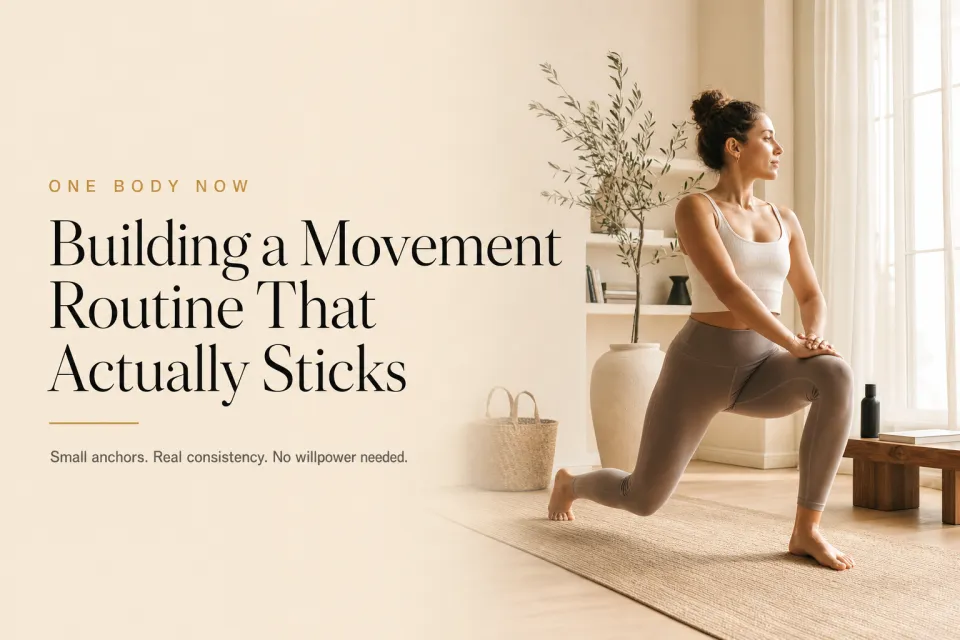
Building a Movement Routine That Actually Sticks
Most movement routines do not fail because people are lazy. They fail because they were built for an ideal version of life, not the real one.
You know the pattern. A fresh burst of motivation arrives. You buy the clothes, open the app, plan the workouts, promise yourself that this time will be different. For a few days, maybe even a few weeks, it works. You feel proud, energised and back in control. Then work gets busy. A meeting runs late. Sleep is poor. Travel interrupts the week. The routine that felt exciting on Monday quietly disappears by Friday.
If that sounds familiar, the problem is not your character. The problem is the design of the routine.
The most reliable way to learn how to build a movement routine that sticks is to stop treating movement as something that depends on motivation, mood or perfect timing. A sustainable movement habit is usually built from tiny, repeatable actions attached to moments that already happen in your day. Morning coffee. Brushing your teeth. Waiting for the kettle. Finishing a call. Arriving home. Closing your laptop.
When movement becomes connected to familiar cues, it becomes easier to repeat. And when it repeats, it becomes part of your identity, not another task on a crowded to-do list.
In this guide, you will learn:
- Why motivation and willpower are unreliable foundations for consistency
- Why ambitious workout plans often collapse when life gets busy
- How to create a movement routine without willpower
- How to use tiny anchors to build a consistent exercise habit
- Practical examples of anchor movements you can use at home, at work or while travelling
- How to avoid workout burnout by focusing on repetition over intensity
- A simple 7-day framework for building an exercise habit that lasts
The routine that lasts is rarely the most impressive one. It is the one that repeats.
This is not about becoming someone else overnight. It is about giving your body a reliable way back into movement, one small action at a time.
Why Motivation Is Not Enough When Learning How to Build a Movement Routine That Sticks
Motivation feels powerful at the beginning because it creates emotional momentum. It gives you the feeling of a fresh start. It helps you imagine a better version of your week, your energy and your relationship with your body. But motivation is also unstable. It rises and falls depending on sleep, stress, workload, weather, mood, social pressure and countless other factors you cannot fully control.
That is why motivation is a useful spark, but a poor system.
Motivation is a state, not a structure
A state is temporary. A structure supports you when the state changes. When your movement routine depends on feeling motivated, it becomes vulnerable to normal human life. You may move when you feel good, but stop when you feel tired, distracted or emotionally overloaded.
A structure does not ask, “Do I feel like moving today?” It asks, “What happens after I finish my coffee?” or “What do I do before I sit down at my desk?” This distinction matters. A daily movement habit becomes more reliable when it is linked to a predictable moment, not a fluctuating emotion.
Willpower gets tired
Willpower is often treated as a personal virtue, but in practice it behaves more like a limited resource. The more decisions you make during the day, the harder it becomes to make another good one later. This is especially relevant for busy professionals, parents, leaders and hybrid workers whose days are full of small decisions.
By evening, “I should exercise” has to compete with emails, dinner, family responsibilities, social messages, unfinished work and the desire to simply stop thinking. A routine built on willpower asks too much at the exact moment people have the least capacity.
Small cues reduce decision fatigue
Habit research has long suggested that behaviours become easier to repeat when connected to consistent cues. In practical terms, this means you do not need to debate whether to move. The cue makes the next action obvious.
For example:
- After brushing your teeth, do 5 slow squats
- After making coffee, do 30 seconds of shoulder circles
- After closing your laptop, take a 5-minute walk
- Before checking your phone in the morning, stand up and stretch for 60 seconds
- Before your first meeting, do one set of calf raises or wall push-ups
These actions are intentionally small. Their power is not intensity. Their power is repetition.
Real-world example: the busy People Director
Imagine a People and Culture Director in London or Paris managing employee wellbeing, leadership requests and hybrid team challenges. She wants to move more, but her calendar is packed. A 45-minute workout at 7:00 am sounds good on Sunday night, but becomes fragile when a child wakes early, a train is delayed or an urgent leadership meeting appears.
Instead, she attaches movement to existing moments. Five squats after brushing teeth. A short walk after lunch. One stretch after every long video call. None of these actions feels dramatic. But after four weeks, she has moved on more days than she would have with a rigid plan.
That is the first principle of a realistic fitness routine: make the action small enough to survive real life.
Why Ambitious Plans Often Collapse When Life Gets Busy
Many people try to restart movement by designing a routine that looks impressive. Five workouts per week. Long sessions. Perfect equipment. Specific time slots. New goals. New rules. At first, this feels inspiring because it creates a strong sense of commitment. But the more complex a routine becomes, the easier it is for one disruption to break the chain.
Ambition is not the enemy. But ambition without flexibility often leads to inconsistency.
The all-or-nothing trap
One of the biggest reasons people lose a movement routine is the belief that the session only “counts” if it looks a certain way. If you planned 45 minutes and only have 8, you skip it. If you miss Monday, the week feels ruined. If you cannot do the full class, you do nothing.
This mindset quietly turns movement into a pass or fail experience. Over time, that creates pressure, guilt and avoidance. A sustainable fitness routine works differently. It gives you several ways to win.
Instead of asking:
- Did I complete the perfect workout?
- Did I train hard enough?
- Did I follow the plan exactly?
Ask:
- Did I repeat my anchor today?
- Did I give my body one useful moment of movement?
- Did I keep the relationship with movement alive?
This shift removes unnecessary pressure. It also makes consistency possible during busy weeks.
Rigid routines are vulnerable routines
A rigid plan depends on very specific conditions. You need the right time, place, energy, clothing, equipment and mental state. If one piece is missing, the routine becomes harder to start.
For example, a plan that requires going to the gym after work might work well in a calm week. But what happens when a meeting runs late? What happens when it rains? What happens when you feel socially drained? What happens when you are travelling?
A flexible movement routine includes a lower threshold. It has a full version, a short version and a minimum version.
- Full version: 30 to 45 minutes of planned movement
- Short version: 10 minutes of simple bodyweight exercises or walking
- Minimum version: 60 seconds attached to a daily anchor
The minimum version matters because it protects the habit. Even when the full routine is not possible, the identity remains intact: “I am someone who moves daily.”
Case study: from three failed restarts to one stable anchor
Consider a senior consultant in Amsterdam who repeatedly tried to restart exercise with three gym sessions per week. Each attempt lasted two or three weeks. The sessions were too dependent on travel, client demands and evening energy. Eventually, he changed the goal from “train three times per week” to “move after the first coffee every workday.”
His anchor was simple: after coffee, 10 lunges, 10 wall push-ups and 30 seconds of mobility. It took less than three minutes. On good days, he added more. On hard days, he stopped there. After two months, he had built more consistency than in the previous year.
The lesson is not that longer training is bad. The lesson is that consistency often begins with a smaller door.
How to avoid workout burnout
Burnout in movement often happens when people do too much too soon, especially after a period of inactivity. The body and mind both need time to adapt. A more grounded approach is to build capacity gradually, without turning every session into a test.
To avoid workout burnout, try:
- Starting with actions that feel almost too easy
- Leaving energy in reserve instead of pushing to exhaustion
- Repeating the same anchor for at least one week before adding more
- Using gentle movement on low-energy days
- Celebrating repetition, not only intensity
Once you understand why ambitious plans collapse, you can build something more durable: movement attached to moments that already exist.
Reframing Routine Around Anchors, Not Perfect Conditions
The most important reframe in this guide is simple: a routine does not need to begin with a new block of time. It can begin by attaching movement to a moment that already happens every day.
This is the foundation of an exercise habit that lasts. Instead of asking your life to make space for a large new commitment, you place a small action beside something familiar.
What is an anchor?
An anchor is an existing behaviour, location or moment that acts as a cue for your next action. It is something you already do without much thought. Because the anchor is already stable, it can carry a new habit more easily than a random time slot.
Common anchors include:
- Brushing your teeth
- Making coffee or tea
- Opening your laptop
- Finishing a meeting
- Parking the car
- Waiting for the kettle
- Arriving home
- Changing clothes
- Before sitting down to dinner
- Before opening social media
The anchor is not the movement. The anchor is the reminder. It reduces the need to remember, decide or negotiate.
The formula for anchor movement
Use this simple sentence:
After I [existing daily action], I will [tiny movement action].
Examples:
- After I brush my teeth, I will do 5 squats
- After I pour my coffee, I will stretch my calves for 30 seconds
- After I end a video call, I will stand and roll my shoulders
- After I park the car, I will walk one extra minute before entering
- Before I open social media, I will do one minute of mobility
The wording matters because it creates a clear connection between cue and action. The more specific the anchor, the easier it is to repeat.
Why anchors work better than scheduling alone
Scheduling can be helpful, especially for longer sessions. But scheduling alone often fails when life shifts. An anchor is more resilient because it is embedded inside a routine you already have.
For example, “I will move at 6:30 pm” depends on the day unfolding as expected. But “after I close my laptop, I will walk around the block” is tied to an actual transition. The movement becomes part of closing work, not a separate obligation floating in the evening.
Real-world example: hybrid work and screen fatigue
In hybrid teams, many employees move less than they realise. Commutes disappear, meeting rooms become browser tabs and the distance between work and rest shrinks to a few steps. One practical response is to add movement to digital transitions.
For example:
- After every second video call, stand for one minute
- Before opening the next document, stretch the wrists and neck
- After sending a long email, walk to refill water
- Before lunch, take a short outdoor loop if possible
These actions do not require a full workout environment. They simply reintroduce the body into a day that has become overly still.
Anchors are powerful because they make movement practical. Next, let us look at the specific anchor movements you can use immediately.
Anchor Movement Ideas for a Daily Movement Habit
Once you understand the anchor concept, the next step is choosing movements that are easy enough to repeat. This is where many people accidentally make the habit too difficult. They choose exercises that require changing clothes, getting equipment, finding privacy or feeling energetic. A better starting point is movement that can happen in normal clothes, in normal spaces, on normal days.
Your first anchor movement should feel almost too easy. That is not a weakness. It is the reason it can repeat.
Morning anchors
Mornings are useful because they contain reliable cues. You probably brush your teeth, make a drink, open curtains, check your phone or put on shoes. Each of these can become a movement trigger.
- After brushing teeth: 5 slow squats or 5 heel raises
- While waiting for the kettle: gentle hip circles or shoulder rolls
- Before checking the phone: 60 seconds of standing mobility
- After making coffee: one set of wall push-ups
- Before putting on shoes: one hamstring stretch per side
Morning movement does not need to be intense. The goal is to give the body an early signal: we move today.
Workday anchors
For many professionals, the workday is where movement disappears. Long periods of sitting can become the default, especially during focused work or back-to-back calls. Workday anchors help you interrupt stillness without disrupting productivity.
- After ending a meeting: stand up and take 10 slow steps
- Before opening a new task: stretch wrists and forearms
- During a work break: do 30 seconds of lunges or a simple standing stretch
- After sending a major email: walk to another room and back
- Before lunch: take a 5-minute walk if your schedule allows
In an office, these movements can be subtle. At home, they can be slightly more expressive. The point is not performance. It is reconnection.
Evening anchors
Evening anchors are helpful because they create a bridge between work and personal time. Instead of collapsing directly from laptop to sofa, a short movement cue can help mark the transition.
- After closing the laptop: walk around the block or inside your home for 5 minutes
- Before sitting down to dinner: do 5 slow bodyweight squats
- After parking the car: walk one extra loop before going inside
- Before changing into evening clothes: stretch hips or calves for one minute
- Before watching a series: do a gentle mobility sequence
Travel anchors
Travel often breaks routines because it removes the usual environment. Anchors solve this by using portable cues.
- After entering a hotel room: unpack, then stretch for one minute
- After brushing teeth away from home: repeat your normal anchor movement
- Before boarding transport: walk instead of sitting when possible
- After arriving at a station or airport: take the longer route if practical
The best anchor movement is the one you can do anywhere. If you want a simple companion for building this style of movement into everyday life, One Rep Now is designed around the idea that movement can begin anywhere, with one repeatable action.
Once you have anchor ideas, the next question is how small movement creates meaningful consistency over time.
How Small Movement Supports Energy, Mood, Sleep and Confidence Over Time
Small movement can feel almost too simple to matter. This is understandable. Many people have been taught that movement only counts when it is intense, long or visibly demanding. But a realistic fitness routine is not built only from standout sessions. It is built from repeated signals that help the body and mind stay engaged with movement.
Short, regular movement may support energy, mood, sleep quality and confidence for many people over time. The key word is “may,” because everyone’s body, schedule and starting point are different. But the general pattern is clear: when movement becomes easier to repeat, people often feel more connected to their bodies and more capable of continuing.
Energy: movement as a transition tool
During a long workday, low energy is not always solved by pushing harder. Sometimes the body simply needs a change of state. Standing, walking, stretching or doing a few controlled repetitions can help interrupt mental fog and physical stiffness.
This is especially useful during screen-heavy work. A 60-second movement anchor between tasks can create a small reset. It gives your eyes, posture and attention a moment away from the same position.
Try this:
- After a long call, stand and reach overhead for 20 seconds
- Before starting deep work, take 10 slow steps
- After lunch, walk for 5 minutes at a comfortable pace
Mood: consistency builds trust
Movement can support mood in different ways for different people. Some enjoy the physical sensation. Some enjoy the mental break. Some enjoy the quiet confidence of keeping a promise to themselves.
The confidence piece is important. When you repeatedly complete a tiny movement anchor, you rebuild trust. You stop seeing movement as something you constantly restart and begin seeing it as something that belongs to you.
This is why the action should be easy at first. A completed easy action often does more for long-term confidence than a dramatic plan that collapses.
Sleep: gentle rhythm, not late-night pressure
Movement and sleep are connected for many people, but the goal here is not to make strong medical claims. A consistent movement rhythm during the day may help some people feel more physically settled by evening. Gentle walking, stretching or mobility can also create a more intentional transition out of work mode.
For example, a short walk after closing the laptop may help separate the workday from the evening. It is not a cure-all. It is a practical boundary.
Confidence: identity follows repetition
Every repeated anchor sends a message: “I am someone who moves.” This identity shift is more valuable than it may appear. Many people do not need more pressure. They need more evidence that consistency is possible.
Over time, your anchor movements can grow naturally:
- One minute becomes three minutes
- Three movements become a simple sequence
- A short walk becomes a regular daily walk
- A morning anchor becomes a fuller weekly routine
This is how an exercise habit that lasts develops. Not by forcing transformation, but by making repetition easier.
How to Build a Movement Routine That Sticks by Connecting It to Daily Triggers
If you want to know how to build a movement routine that sticks, focus less on the workout itself and more on the trigger that starts it. A good trigger removes ambiguity. It tells you exactly when the movement happens. Without a trigger, movement remains an intention. With a trigger, it becomes a sequence.
The trigger should be specific, frequent and already part of your life.
Choose triggers that are stable
A stable trigger is something that happens even on imperfect days. Brushing your teeth is more stable than “when I have time.” Making coffee is more stable than “after work, if I feel good.” Closing your laptop is more stable than “sometime in the evening.”
Strong triggers include:
- After brushing teeth
- After using the bathroom in the morning
- After making tea or coffee
- Before opening email
- After the first meeting of the day
- Before lunch
- After parking the car
- Before sitting down to dinner
Weak triggers are vague. “Later,” “after work,” “when I get a chance” and “when I feel motivated” all require fresh decision-making. The goal is to remove that decision.
Use the smallest useful movement
Once you choose a trigger, attach a movement so small that resistance is low. If the movement feels too demanding, your mind will start negotiating. If it feels simple, you are more likely to begin.
Examples of small useful movements:
- 5 bodyweight squats
- 5 wall push-ups
- 10 heel raises
- 30 seconds of shoulder mobility
- 60 seconds of walking
- One gentle stretch per side
Remember, you can always do more after starting. The anchor is only the doorway.
Make the cue visible
Sometimes the environment needs to remind you. Small visual cues can help, especially during the first two weeks.
- Place a note near the kettle: “Move for one minute”
- Put your walking shoes by the door
- Leave a mat visible, not hidden in a cupboard
- Set a simple calendar note after recurring meetings
- Use a recurring phone reminder, but attach it to a real-world action
The best environment makes the next action obvious.
Real-world example: the social media anchor
Many people check social media several times per day. Instead of judging that behaviour, use it. Create the rule: “Before I open social media, I do one minute of movement.”
This could be:
- 10 squats
- 30 seconds of stretching
- 10 slow steps around the room
- 5 incline push-ups against a desk
The goal is not to punish phone use. The goal is to place movement before a behaviour that already repeats. This is a practical way to create a movement routine without willpower.
Once your triggers are clear, you can begin designing a routine that fits home, office and hybrid work realities.
Designing a Realistic Fitness Routine for Home, Office and Hybrid Work
A movement routine is more likely to last when it respects the context of your life. Someone working from home needs different anchors than someone commuting across a city. A parent needs different options than a frequent traveller. A senior leader with back-to-back meetings needs different strategies than someone with flexible mornings.
The best routine is not the most fashionable. It is the one that fits your real environment.
At home: use transitions between rooms
Home routines are often easier to start because privacy is higher and clothing is less restrictive. But working from home can also blur boundaries. It becomes easy to sit for long stretches without the natural movement that an office creates.
Useful home anchors include:
- After leaving the bedroom, stretch for 30 seconds
- Before sitting at the desk, do 5 squats
- After every bathroom break, walk to a window and back
- Before lunch, take one short outdoor loop
- After closing the laptop, move for 5 minutes before starting the evening
Home movement works best when the space is prepared. Keep the floor clear. Leave shoes visible. Place a mat where you will see it. Make movement easy to start.
At the office: choose subtle, professional movements
Office movement does not need to attract attention. In fact, subtle options are often more sustainable because they feel socially comfortable.
Try:
- Taking stairs for one floor
- Standing during short calls
- Walking to speak to a colleague instead of messaging when appropriate
- Doing calf raises while waiting for coffee
- Stretching wrists after long typing blocks
For teams, leaders can normalise movement by building it into culture without making it performative. A manager might open a long workshop with a 60-second stand and stretch. A People team might encourage walking one-to-ones. The key is to make movement feel human, not forced.
In hybrid work: create location-independent anchors
Hybrid work can disrupt routine because no two days look exactly the same. This is why portable anchors are essential. Choose cues that happen regardless of location.
- After brushing teeth
- Before opening email
- After the first meeting
- Before lunch
- After closing the laptop
These anchors travel between home, office, hotel and coworking space. They are not dependent on a specific room or piece of equipment.
For organisations: movement as a culture signal
For People and Culture leaders, movement routines can be part of a broader employee wellbeing strategy without becoming complicated. The opportunity is to help employees build small daily behaviours rather than offering benefits that look good but go unused.
Practical workplace ideas include:
- Meeting-free walking windows where possible
- Optional movement prompts during wellbeing campaigns
- Team challenges based on consistency, not intensity
- Short guided movement breaks during long offsites
- Encouraging managers to model healthy transitions between work blocks
This aligns closely with the philosophy behind One Body Now: your body, your mind, one action now. The emphasis is on small, practical actions that people can actually use in daily life.
Once the environment fits the routine, the next step is keeping the routine fresh without making it overwhelming.
How to Avoid Workout Burnout While Building a Consistent Exercise Habit
To build a consistent exercise habit, you need enough structure to repeat and enough flexibility to adapt. Too little structure makes the routine easy to forget. Too much intensity can create pressure, soreness, boredom or avoidance. The sweet spot is a rhythm that feels steady, manageable and respectful of your current capacity.
This is especially important if you are returning to movement after a break. The goal is not to prove how much you can tolerate. The goal is to create a relationship with movement that you want to continue.
Start below your maximum
Many people restart movement at a level that reflects their ambition, not their current baseline. They remember what they used to do, then try to resume at that level immediately. This often creates frustration because the body has changed, the schedule has changed or recovery capacity has changed.
A more sustainable approach is to begin below your maximum. Finish your movement feeling like you could do a little more. This makes it easier to return tomorrow.
For example:
- Instead of 30 squats, start with 5
- Instead of a 45-minute workout, start with 8 minutes
- Instead of running every day, start with short walks
- Instead of intense sessions, start with mobility and controlled bodyweight movement
Use variety without chaos
Variety helps keep movement interesting, but too much variety can create decision fatigue. The solution is to rotate within a simple menu.
Example weekly movement menu:
- Lower body: squats, lunges, step-ups, calf raises
- Upper body: wall push-ups, incline push-ups, arm circles
- Mobility: hip circles, spinal rotations, shoulder rolls
- Walking: short loops, post-meal walks, walking calls
You do not need a new routine every day. You need enough familiarity to repeat and enough choice to stay engaged.
Respect low-energy days
A routine that only works on high-energy days will not last. Low-energy options are essential. They keep the habit alive without forcing intensity.
Low-energy movement options include:
- One minute of stretching
- A slow walk around the block
- Gentle shoulder and neck mobility
- Standing up during a call
- Five controlled squats
These are not failures. They are continuity tools.
Watch for early signs of burnout
Movement burnout can appear as dread, irritability, constant negotiation, repeated skipping or the feeling that every session is a burden. If that happens, do not immediately assume you lack discipline. Your routine may simply be too demanding for your current life.
Adjust by:
- Reducing session length
- Lowering intensity
- Returning to one anchor movement
- Changing the time of day
- Removing unnecessary rules
A routine that lasts should feel like support, not another source of pressure.
Making Movement Automatic Through Environment Design
If consistency is the goal, your environment matters as much as your intention. The spaces you move through each day either make movement easier or harder. A well-designed environment reduces friction. It places reminders where you need them, removes unnecessary barriers and makes the next action feel natural.
This is one of the most overlooked parts of building a sustainable fitness routine. People often focus on motivation, but the room, the calendar, the shoes, the desk and the phone all influence behaviour.
Reduce friction before it appears
Friction is anything that makes movement harder to start. It can be physical, mental or social.
Common friction points include:
- Workout clothes hidden away
- No clear space to move
- Uncertainty about what to do
- Feeling watched or self-conscious
- Too many exercise choices
- A plan that requires equipment you do not have nearby
Reduce friction by making the first step obvious. If your anchor is morning mobility, keep a small space clear. If your anchor is a walk after lunch, place shoes near the door. If your anchor is movement after meetings, write one movement option on a note beside your screen.
Create visible cues
Visible cues are especially useful during the early phase of habit formation. They do not need to be loud or unattractive. A premium, calm environment can still contain subtle prompts.
Examples:
- A folded mat in a visible corner
- Walking shoes placed neatly near the entrance
- A small note inside a notebook: “After call, stand”
- A calendar block named “Move for 5 minutes”
- A water glass placed away from the desk, encouraging you to stand
The goal is not to clutter your life. The goal is to make movement easier to remember.
Design for your weakest moment
Do not design your routine for the version of you who slept well, finished work early and feels inspired. Design it for the version of you who is tired, busy and slightly distracted. If the routine works then, it will work often.
Ask yourself:
- What is the smallest movement I would still do on a difficult day?
- Where do I naturally pause during the day?
- What object could remind me without annoying me?
- Which movement requires no clothing change?
- Which anchor happens even when my schedule changes?
Real-world example: the kettle routine
A simple kettle routine can be surprisingly effective because the cue is concrete. While waiting for water to boil, you can do:
- 10 heel raises
- 5 slow squats
- 20 seconds of shoulder circles
- 20 seconds of side bends
This may take less than two minutes. But if repeated daily, it becomes a reliable movement ritual. It fits the kitchen, the office kitchenette, a hotel room and a shared workspace. It is not impressive. It is repeatable.
Once the environment supports movement, you can use simple tracking to strengthen consistency without becoming obsessive.
Tracking an Exercise Habit That Lasts Without Turning It Into Pressure
Tracking can be helpful, but only if it supports the habit rather than becoming another source of stress. The purpose of tracking is not to judge yourself. It is to create awareness, celebrate repetition and notice patterns. A good tracking method makes your daily movement habit more visible.
For many people, the biggest motivation comes from seeing proof that small actions are adding up.
Track the anchor, not perfection
Instead of tracking calories, intensity or long sessions, track whether you completed your anchor. This keeps the focus on consistency.
For example, your tracker might simply ask:
- Did I move after brushing my teeth?
- Did I stand after my first meeting?
- Did I walk after lunch?
- Did I do one minute before opening social media?
A simple yes or no is enough. You are not trying to create a performance report. You are trying to reinforce repetition.
Use a visible streak carefully
Streaks can be motivating, but they can also create pressure. If you miss a day, you may feel as if the habit is broken. A healthier approach is to track frequency rather than perfection.
Instead of “never miss,” try:
- Move on 5 out of 7 days
- Complete 10 anchors this week
- Repeat the morning anchor every weekday
- Take 3 post-lunch walks this week
This gives you room to be human.
Review patterns weekly
At the end of each week, spend two minutes reviewing what worked. Keep it simple.
Ask:
- Which anchor was easiest to repeat?
- Which one did I resist?
- What time of day felt most natural?
- What got in the way?
- What should I make smaller next week?
If an anchor is not working, change the design. Do not turn it into a personal failure.
For teams: measure participation, not intensity
For organisations, tracking should be respectful, inclusive and focused on participation. A workplace movement initiative should not reward only the fittest employees or create comparison. Instead, measure engagement with small behaviours.
Examples:
- Number of employees joining optional movement prompts
- Participation in a 7-day anchor challenge
- Feedback on energy and usability
- Number of teams trying walking meetings
- Self-reported consistency, not performance metrics
This approach is more inclusive because it allows people with different schedules, bodies and fitness levels to participate. It also aligns with what many modern employees want from wellbeing: practical tools that fit real working lives.
For more ideas on movement and daily practice, you can explore The Journal’s movement articles.
Turning One Anchor Into a Sustainable Fitness Routine
Once one anchor feels natural, you can expand carefully. This is where many people rush. They complete a few good days, feel excited and immediately add too much. The better approach is to let the routine grow in layers.
A sustainable fitness routine is not a single giant commitment. It is a collection of small reliable behaviours that support each other.
Layer 1: one anchor
Start with one anchor only. Choose the easiest cue in your day and attach one tiny movement.
Example:
- After brushing teeth, do 5 squats
Repeat this for at least 7 days before adding anything else. The goal is not to feel challenged. The goal is to make the connection automatic.
Layer 2: one sequence
Once the anchor feels familiar, you can turn it into a short sequence.
Example:
- 5 squats
- 5 wall push-ups
- 20 seconds of shoulder rolls
This still takes only a few minutes. It remains easy to repeat.
Layer 3: one daily movement window
Next, add a flexible window. This is not a rigid workout appointment. It is a preferred time for slightly longer movement when possible.
Examples:
- Walk for 10 minutes after lunch
- Move for 8 minutes after closing the laptop
- Stretch for 5 minutes before dinner
If the window is missed, the anchor still protects the habit.
Layer 4: one weekly longer session
After the daily anchor is stable, you may choose to add one longer weekly session. This could be a class, a gym visit, a longer walk, a home session or a sport you enjoy.
The difference is that the longer session is now supported by a daily movement identity. You are not relying on one big workout to carry the entire week.
Real-world example: the 3-minute foundation
A creative agency director in Barcelona wanted a routine but struggled with inconsistent hours. She started with a 3-minute morning sequence after coffee. After two weeks, she added a 10-minute walk after lunch three days per week. After six weeks, she began attending one weekend class because her confidence had returned.
Her routine did not stick because she found perfect motivation. It stuck because each layer was small enough to repeat.
If you want guided support for this kind of gradual consistency, One Rep Now can help turn simple movement actions into a daily practice that travels with you.
Expert Tips and Pro Strategies for a Movement Routine Without Willpower
Once you understand anchors, you can refine the system. These strategies are useful if you have tried many routines before, lead a busy team or want a more mature approach to consistency.
Use identity-based language
The way you describe your routine matters. Instead of saying, “I am trying to work out again,” say, “I move after coffee.” This makes the habit concrete and present-tense. It also removes the pressure of becoming a completely different person.
Identity-based phrases include:
- I move for one minute before checking my phone
- I walk after lunch when I can
- I stand after long calls
- I keep promises small enough to repeat
Pair movement with transitions, not tasks
Transitions are powerful because the day is already changing. The body is moving from one context to another. This makes it easier to insert a short action.
Good transitions include:
- Sleep to morning
- Home to work
- Meeting to focus time
- Work to evening
- Outside to inside
Instead of interrupting flow, movement becomes the bridge.
Avoid these common mistakes
- Starting too big: If the routine feels heroic, it may be too fragile.
- Changing everything at once: One anchor repeated is better than five anchors forgotten.
- Tracking too much: Measure consistency first, details later.
- Waiting for confidence: Confidence usually follows repetition.
- Copying someone else’s routine: Your anchors must fit your real life.
Use the “minimum plus” method
The minimum plus method is simple. Complete the minimum anchor first. Then ask, “Do I want to add a little more?” If yes, continue. If no, stop proudly.
Example:
- Minimum: 5 squats after brushing teeth
- Plus option: add 5 wall push-ups
- Extra option: add a 5-minute walk
This keeps movement voluntary and supportive. You are not trapped by the routine. You are invited by it.
Recommended tools and resources
- A simple habit tracker: Paper, notes app or calendar ticks are enough
- Comfortable shoes: Make walking easier to choose
- A visible mat: Reduce friction for floor-based mobility
- Recurring calendar cues: Use them for transitions, not random reminders
- Editorial inspiration: Read practical movement guidance on The Journal by One Body Now
Advanced consistency is not about doing more. It is about designing better.
A 7-Day Framework for Building a Movement Routine That Actually Sticks
This 7-day framework helps you move from one anchor to a small repeatable routine. Keep it simple. The goal is not to complete a dramatic challenge. The goal is to prove that movement can fit inside your actual life.
- Day 1: Choose one anchor.
Pick a daily cue that already happens, such as brushing teeth, making coffee or closing your laptop. Pro tip: choose the most predictable moment, not the most ambitious one. - Day 2: Attach one tiny movement.
Select an action that takes 30 to 60 seconds. Try 5 squats, 10 heel raises, shoulder rolls or a short walk. Pro tip: if it feels too easy, you chose well. - Day 3: Make the cue visible.
Add a small reminder near the anchor point. Shoes by the door, a note by the kettle or a mat in sight. Pro tip: design the environment before motivation fades. - Day 4: Repeat without adding.
Do the same anchor again. Resist the urge to expand too quickly. Pro tip: repetition builds the foundation. - Day 5: Add a plus option.
After completing the minimum, add one optional extra if you want. Pro tip: the minimum still counts, even if you stop there. - Day 6: Test it on a busy day.
Use the anchor even if the day is imperfect. Pro tip: a routine that survives a busy day is more valuable than one that only works in ideal conditions. - Day 7: Review and refine.
Ask what felt easiest, what got in the way and what you will repeat next week. Pro tip: adjust the routine, not your self-worth.
After 7 days, you should have one reliable movement anchor. That is enough to begin. From there, you can add a second anchor, a short walk or one longer weekly session.
Simple Checklist: How to Build a Movement Routine That Sticks
Use this checklist when you want to start, restart or simplify your routine.
- Choose one daily cue.
Use something you already do every day, such as brushing teeth, making coffee, opening your laptop or sitting down to dinner. - Pick one tiny movement.
Choose an action that takes less than one minute. Squats, shoulder rolls, heel raises, walking and gentle stretching all work. - Write the anchor sentence.
Use: “After I [existing action], I will [movement].” Clarity removes negotiation. - Prepare the environment.
Put shoes, notes, mats or visual cues where they support the habit. - Repeat for 7 days before expanding.
Do not rush. Let the connection become familiar. - Create a minimum version.
Decide what counts on difficult days. One minute is acceptable if it keeps the habit alive. - Track completion gently.
Use a tick, note or simple yes or no. Avoid turning tracking into pressure. - Review weekly.
Keep what works. Make what does not work smaller, simpler or better placed.
The best routine is not the one that demands the most from you. It is the one that keeps inviting you back.
Conclusion: Start With One Anchor, Then Build From There
Learning how to build a movement routine that sticks is not about finding endless motivation. It is about creating a structure that supports you when motivation changes.
The key takeaways are simple:
- Motivation can start a routine, but anchors help it last
- Small movement repeated often is more sustainable than ambitious plans that collapse
- Attach movement to daily cues you already have
- Use a minimum version for busy or low-energy days
- Track consistency gently, without pressure or perfectionism
- Let the routine grow in layers over time
Movement does not need to begin with a dramatic transformation. It can begin after coffee, before dinner, during a work break or before opening your phone. One small action, repeated often, can change the way you relate to your body.
Start with one anchor. Not because it is impressive, but because it repeats. One Body Now helps you build from there.
If you are ready to create a practical daily movement rhythm for yourself or your team, explore One Body Now or contact the team to learn more.
Frequently Asked Questions
How do I build a movement routine that actually sticks?
To build a movement routine that actually sticks, start with one tiny action attached to something you already do every day. For example, after brushing your teeth, do 5 squats. After making coffee, stretch for 30 seconds. After closing your laptop, take a short walk. The key is to connect movement to a stable daily cue rather than relying on motivation or a perfect schedule. Keep the first action very small, repeat it for at least a week and only expand once it feels natural.
Why do I keep starting exercise routines and then stopping?
Many exercise routines disappear because they depend on motivation, energy and ideal conditions. At the beginning, motivation makes the plan feel easy. But when work gets busy, sleep changes or stress rises, the routine becomes harder to maintain. Often the plan is also too ambitious too soon. A more sustainable approach is to lower the starting point and attach movement to existing daily moments. This turns movement into a repeatable behaviour rather than another decision you must force yourself to make.
What is an anchor movement?
An anchor movement is a small movement action attached to a familiar daily cue. The cue is something you already do, such as brushing your teeth, waiting for the kettle, finishing a meeting or parking the car. The movement is intentionally simple, such as 5 squats, 10 heel raises, shoulder rolls or a one-minute walk. The anchor makes the behaviour easier to remember and repeat. Over time, this can help create a consistent exercise habit without depending on willpower.
How small should my first movement habit be?
Your first movement habit should be small enough that it feels easy even on a busy day. A good starting point is 30 to 60 seconds. Examples include 5 squats, 5 wall push-ups, 10 heel raises, one gentle stretch per side or walking around the room. If the action feels too easy, that is often a good sign. The first goal is not intensity. The first goal is repetition. Once the habit feels natural, you can add more time, variety or challenge.
Can one minute of movement really make a difference?
One minute of movement is not meant to replace all other physical activity. Its value is that it lowers the barrier to starting and helps build consistency. Many people struggle not because they cannot move for long periods, but because they cannot repeat the habit reliably. A one-minute anchor keeps the relationship with movement alive, especially during busy weeks. Over time, one minute often becomes three, then five, then a fuller routine. Small actions can create momentum when they repeat.
What are the best daily triggers for a movement habit?
The best daily triggers are stable moments that already happen without much thought. Good examples include brushing your teeth, making coffee, opening your laptop, ending a meeting, waiting for the kettle, parking the car, arriving home, before sitting down to dinner or before opening social media. Choose a trigger that happens most days, even when life is busy. The more predictable the trigger, the easier it becomes to attach a movement habit that lasts.
How can I build a movement routine without willpower?
To build a movement routine without willpower, reduce the number of decisions involved. Decide in advance: “After I do this daily action, I will do this tiny movement.” For example, “After I close my laptop, I will walk for five minutes.” This removes the need to ask whether you feel like moving. You can also make the environment easier by placing shoes near the door, keeping a mat visible or writing a reminder near your desk. Structure replaces willpower.
What if I miss a day?
Missing a day does not mean the routine has failed. A sustainable movement routine should have room for real life. Instead of trying to be perfect, aim to return to the anchor at the next opportunity. If you miss your morning movement, use an evening anchor. If you miss a full day, restart the next day with the smallest version. Avoid turning one missed day into a story about failure. Consistency is built by returning, not by never slipping.
How long does it take to build a consistent exercise habit?
There is no exact timeline that applies to everyone. Habit formation depends on the behaviour, the cue, the environment and the person’s schedule. Very small actions attached to stable daily cues are generally easier to repeat than large actions added randomly to the calendar. Instead of focusing on a fixed number of days, focus on making the habit easier to repeat. If your anchor feels natural after one or two weeks, you can gradually add another layer.
How do I avoid workout burnout when restarting movement?
To avoid workout burnout, start below your maximum and build gradually. Many people restart too aggressively, then feel sore, tired or discouraged. Choose movements that leave you feeling capable rather than depleted. Use a minimum version for low-energy days, such as one minute of stretching or a short walk. Avoid all-or-nothing thinking. A gentle day still counts if it protects the habit. Repetition over time is more sustainable than pushing hard for a few days and stopping.
What is a realistic fitness routine for busy professionals?
A realistic fitness routine for busy professionals should include movement that fits into existing transitions. For example, stretch after long calls, walk after lunch, stand during short meetings, do 5 squats before sitting down to dinner or move for one minute before checking your phone. Longer sessions can be useful, but they should not be the only way the routine counts. A practical routine includes full, short and minimum versions so it can survive busy workdays.
How can companies encourage employees to move more without pressure?
Companies can encourage movement by making it optional, practical and inclusive. Instead of competitive fitness challenges, focus on small daily actions that different employees can adapt to their bodies and schedules. Examples include walking meetings, gentle movement breaks during long workshops, team anchor challenges and reminders to stand between video calls. Measure participation and feedback rather than intensity. The aim is to create a culture where movement feels normal, accessible and supportive, not performative or forced.
What should I do once my first anchor becomes easy?
Once your first anchor feels easy, expand slowly. You can add one extra movement to create a short sequence, increase the duration slightly or add a second anchor at another time of day. For example, 5 squats after brushing teeth might become 5 squats, 5 wall push-ups and 30 seconds of shoulder mobility. Keep the minimum version in place so the habit remains manageable on busy days. Growth should feel natural, not overwhelming.
Do I need equipment to build a daily movement habit?
No, you do not need equipment to build a daily movement habit. Bodyweight movements, walking, stretching and mobility are enough to begin. In fact, equipment can sometimes create friction if it makes the habit feel more complicated. Start with movements you can do in normal clothes and normal spaces. Later, if you enjoy using a mat, weights or other tools, you can add them. The foundation is not equipment. The foundation is repetition.
What is the easiest movement routine to start today?
The easiest routine is one anchor and one tiny movement. Choose a cue that will happen today, such as brushing your teeth, making tea or closing your laptop. Then attach a simple action, such as 5 squats, 10 heel raises, 30 seconds of shoulder rolls or a one-minute walk. Write the sentence clearly: “After I make coffee, I will do 5 squats.” Repeat it tomorrow. That is enough to begin building a movement routine that actually sticks.
Quotes for “Building a Movement Routine That Actually Sticks”
“You do not rise to the level of your goals. You fall to the level of your systems.”
- James Clear, Atomic Habits
“What you do every day matters more than what you do once in a while.”
- Gretchen Rubin, The Happiness Project
“The most reliable way to change your life is by changing your habits.”
- BJ Fogg, Tiny Habits
“Exercise is not just something you do for your body. It is something you do for your brain.”
- Dr. John J. Ratey, Spark: The Revolutionary New Science of Exercise and the Brain
“Movement is not just about health; it is about pleasure, connection, and meaning.”
- Kelly McGonigal, The Joy of Movement
Book Recommendations
- Atomic Habits by James Clear
A practical guide to building habits through small, repeatable actions. This book is especially useful for creating a movement routine because it focuses on systems, identity-based habits, habit stacking, and making behaviors easier to repeat. - Tiny Habits by BJ Fogg
Fogg explains how lasting behavior change starts with tiny, low-pressure actions. It is ideal for anyone who struggles to stay consistent with exercise and needs a routine that feels easy enough to begin every day. - No Sweat: How the Simple Science of Motivation Can Bring You a Lifetime of Fitness by Michelle Segar
This book challenges the idea that exercise must be driven by weight loss or discipline. Segar shows how choosing movement that feels rewarding in the present can make fitness more sustainable. - The Power of Habit by Charles Duhigg
Duhigg breaks down the habit loop: cue, routine, and reward. This is a helpful framework for understanding why movement habits fail and how to redesign them so they become automatic. - The Joy of Movement by Kelly McGonigal
A motivating look at how movement improves mood, connection, confidence, and resilience. This book is great for reframing exercise as something meaningful and enjoyable rather than another obligation. - Spark: The Revolutionary New Science of Exercise and the Brain by John J. Ratey, MD
Ratey explores how movement supports brain health, focus, mood, and stress resilience. It is a strong recommendation for readers who need a deeper “why” behind building a consistent movement routine. - Move Your DNA by Katy Bowman
Bowman encourages readers to think beyond formal workouts and incorporate more natural movement into daily life. This is especially useful for building a routine that fits into real schedules rather than depending only on gym time.