The quick answer
- Does rebounding drain your lymph? It probably helps it move, because lymph depends on muscle contraction, breathing and pressure changes. There are no large studies that prove a dramatic effect in healthy adults.
- Does a vibration plate? It makes your muscles contract reflexively and can boost local circulation. It's a useful warm-up tool, not a replacement for exercise.
- What's the real win? Both make it easy to move a little, often. For a lymph system with no pump, frequent gentle movement is what matters most.
- Start here: 1 minute of slow breathing, 3 minutes of gentle bouncing on a rebounder or the floor, then 1 minute of long exhales.
- Skip it or check first if: you're pregnant or postpartum, or you have pelvic floor symptoms, unexplained swelling, dizziness, recent surgery or a heart condition.
It's 4 pm. Sophie, a 38-year-old consultant, has been at her desk since 8. Her ankles feel puffy, her shoulders are up by her ears, and she's somehow both exhausted and wired. She trains hard twice a week. It doesn't seem to help.
Here's something most people never learn: your heart pumps your blood, but nothing pumps your lymph. This quiet drainage network moves fluid, immune cells and waste through your body, and it relies almost entirely on you moving, contracting muscles and breathing. Sit still for eight hours and it slows right down.
That's why rebounding (bouncing on a mini trampoline) and vibration plates have become so popular. Both promise to "get your lymph moving" in minutes. Some of that promise holds up. Some of it is marketing.
This guide separates the two. You'll learn how lymph moves, what rebounding and vibration actually do, who should be careful, and a routine you can start today in five minutes.
Your lymphatic system, in plain language
Your lymphatic system is part of both your circulatory and immune systems. It keeps fluid balanced, carries immune cells, absorbs fats from digestion and clears waste from the spaces around your cells.
Lymph itself is a clear fluid. It forms when plasma leaks out of your blood vessels into the tissues. It picks up proteins, immune cells and debris, then travels through lymph vessels and nodes before it rejoins your bloodstream near the collarbone.
The main parts:
- Lymph vessels: thin channels with one-way valves that carry lymph through the body
- Lymph nodes: filtering hubs in your neck, armpits, abdomen and groin, where immune cells check for threats
- Spleen and thymus: organs that filter blood and help immune cells develop
- Lacteals: lymph vessels in the small intestine that absorb dietary fat
Why movement matters so much
With no central pump, lymph moves mainly through:
- skeletal muscles squeezing the vessels as you move
- your diaphragm changing pressure in your chest and belly as you breathe
- changes in body position and gravity
- one-way valves that stop fluid flowing backwards
- small rhythmic contractions in the vessel walls themselves
Every walk, stretch, deep breath or change of posture gives lymph a push. Long hours of sitting and shallow breathing remove most of those pushes.
A note on "sluggish lymph": puffiness, heaviness and stiffness have many possible causes, including sleep, hormones, salt, alcohol, stress and medical conditions. Gentle movement is a sensible habit either way. But swelling that is persistent, painful or on one side only needs a doctor, not a trampoline.
Rebounding: why gentle bouncing works
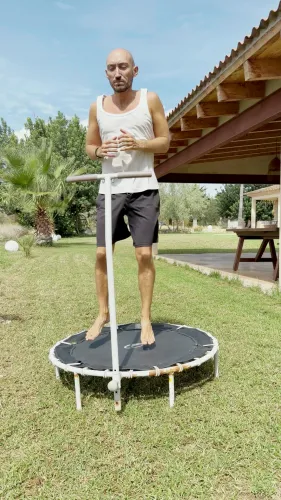
Rebounding is exercise on a mini trampoline. It ranges from a gentle "health bounce", where your feet barely leave the mat, to full cardio sessions.
Its link to lymph comes from simple physics. Each bounce creates a cycle of acceleration and deceleration. Your tissues compress on the way down and release on the way up. Your calves, thighs, glutes, core and feet work non-stop to keep you stable. That combination of muscle contraction and pressure change is exactly what lymph responds to.
What it's good for
- Circulation: rhythmic movement helps both blood and lymph move through tissues
- Balance and coordination: the unstable surface trains the sense of where your body is in space
- A fast lift in energy: your heart rate rises quickly, even in short sessions
- Kinder to many joints: a good mat absorbs some of the impact that pavement doesn't
- Fitting into real life: five minutes is enough to count
The real power of rebounding is that it lowers the barrier to moving. Someone too drained for a 45-minute gym session can usually manage three minutes of bouncing before a shower. Done daily, that's what rebuilds consistency. (More on this in Moving Your Body on Low-Energy Days.)
How to start
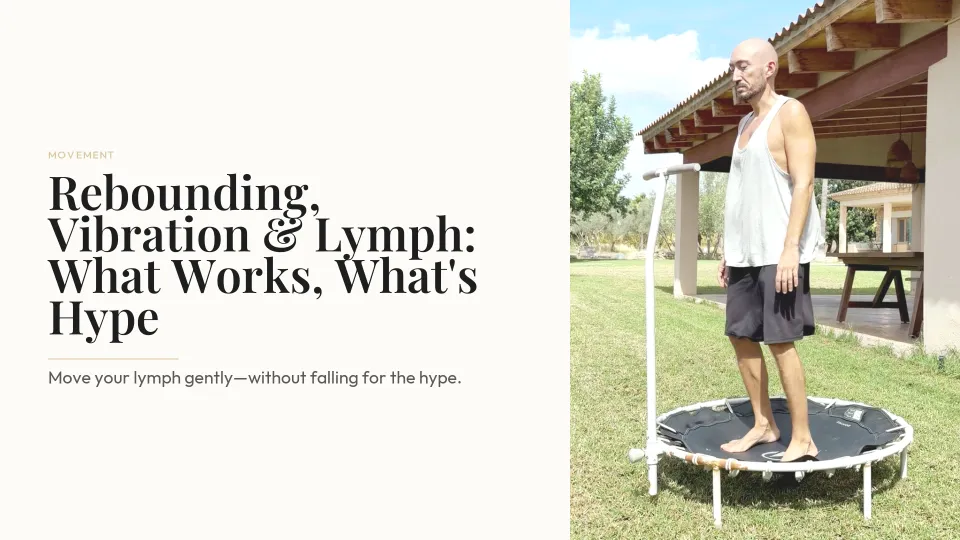
- Use a stable rebounder, with a handle bar if your balance is uncertain.
- Stand with feet hip-width apart and knees soft.
- Start with a health bounce: keep your feet on the mat and gently pulse.
- Keep the first sessions to 2–5 minutes.
- Stop if you feel dizzy, unsteady or any pain.
No rebounder? Bounce from the floor
You don't need any equipment to get most of the benefit. A gentle bounce on the floor uses the same ingredients: rhythmic muscle contraction, pressure changes and a lift in heart rate. The trade-off is more impact, because the floor doesn't give.
Four floor bounces, from gentlest to strongest
- Heel drops: rise onto the balls of your feet, then let your heels drop lightly to the floor. Do 30–60 reps, staying relaxed. This is the gentlest option and works for anyone who can't jump.
- Knee-bend bounce: keep your feet on the floor and bounce softly through your knees and ankles, like the health bounce on a rebounder. Let your arms and shoulders shake loose.
- Low pogo hops: tiny hops a couple of centimetres off the floor, landing softly on the balls of your feet. Do 20–30 seconds, then rest.
- Skipping without a rope: light, alternating hops on the spot. Do 30 seconds on, then 30 seconds easy.
Make it kinder on your body
- Bounce on a mat, carpet or grass, not tiles or concrete.
- Wear supportive trainers, or go barefoot on a soft surface if your feet are used to it.
- Land quietly. If your landings are loud, make the hop smaller.
- Start with 1–2 minutes and build up over a couple of weeks.
- The safety and pelvic floor advice below matters even more here, because the impact is higher. If you're unsure, start with heel drops.
Vibration plates: what they actually do
A whole-body vibration plate shakes at a set frequency and amplitude while you stand, hold a position or exercise on it. Your muscles respond with small reflexive contractions, often many per second, to keep you stable.
Those contractions can raise muscle activation and local circulation. Add squats, calf raises or lunges and simple moves feel noticeably harder. Research suggests vibration training can improve balance, strength and function in older adults and some clinical groups when it's used well. Results for bone health are mixed, and vibration doesn't replace strength training.
The three main types
- Vertical: moves straight up and down. Often used for strength and athletic training.
- Oscillating (pivotal): tilts side to side like a seesaw. Often sold for general wellness and circulation.
- Tri-planar: moves in several directions and usually feels more intense.
Beginners do best with low settings and simple positions, whichever type they choose.
Five beginner moves
- Soft-knee stand: stand tall with knees unlocked for 1 minute.
- Calf raises: rise and lower slowly for 30–60 seconds.
- Mini squat hold: sit your hips back slightly and hold for 20–30 seconds.
- Split stance: one foot slightly forward, to challenge balance.
- Slow squats: 8–12 reps, then rest and breathe for 30 seconds.
Breathe slowly throughout, so your jaw, neck and shoulders don't tense up. Skip passive standing while scrolling your phone. Vibration works best as an active warm-up.
Rebounder, floor or vibration plate?
ReboundingFloor bouncingVibration plate
How it works | You bounce actively | You bounce on the spot | The plate moves you
Feels like | Playful, cardio | Simple, more impact | Buzzing, muscle activation
Heart rate | Rises quickly | Rises quickly with hops | Rises only if you add exercise
Best for | Energy, cardio, balance | Anywhere: home, office, travel | Warm-ups, activation, people who can't jump
Space | About 1 m across, often foldable | A mat's worth of floor | Compact, but heavy
Typical price | €60–400 | Free | €150–1,500+
Prices are approximate ranges for home models.
Evidence vs hype: what to believe
The honest summary: rebounding and vibration are plausible ways to support lymph flow, and the case rests on movement physiology rather than large trials of the devices themselves.
What we know
- Lymph moves when muscles contract, the diaphragm moves and body position changes. That's well established.
- Both rebounding and vibration create repeated muscle contractions and pressure changes.
- A 1980 NASA-linked study found trampoline jumping produced more mechanical stimulus than running at the same heart rate. It measured load on the body, not lymph flow.
- Vibration training has trial evidence for balance and strength, mainly in older adults.
What we don't know
No large study shows that rebounding dramatically increases lymph drainage in healthy adults. Claims like "rebounding increases lymph flow 15 to 30 times" circulate widely online, but they have no solid published source.
What to be sceptical of
- Claims that a rebounder "detoxes your whole body" in minutes. Your liver, kidneys, lungs, gut and lymph system do that all day.
- Promises of effortless fat loss without changes to food or strength training.
- Anything saying a vibration plate replaces exercise.
- Before-and-after photos, which usually show temporary water shifts.
- Advice to keep bouncing through pain, dizziness or pelvic floor symptoms.
What you can reasonably expect
With regular use, most people feel warmer, looser, more awake and more motivated to move. Rebounding can build cardio fitness if you progress it. Vibration can sharpen warm-ups and balance work. The biggest benefit is often the simplest one: you sit less and move more often.
Safety first: who should be careful
Both tools are fine for most healthy adults. Some people should talk to a doctor or physio before starting.
ConditionReboundingVibration plate
Pregnancy or recent childbirth | Check first | Avoid unless cleared
Pelvic floor symptoms or prolapse | Check first | Check first
Severe osteoporosis | Check first | Check first
Recent surgery, injury or joint replacement | Check first | Check first
Vertigo or balance disorders | Check first | Check first
Heart disease or uncontrolled blood pressure | Check first | Check first
Blood clots or unexplained leg swelling | Check first | Avoid unless cleared
Pacemaker or other implant | Usually fine, check first | Avoid unless cleared
Lymphoedema or cancer-related swelling | Only with your specialist | Only with your specialist
Retinal problems | Check first | Avoid unless cleared
Your pelvic floor
Bouncing puts real load on the pelvic floor, especially after childbirth, around menopause or with stress leaking. If you notice leaking, pressure, heaviness or discomfort, stop. Heel raises, marching, strength work and a session with a pelvic floor physio are better starting points.
Signs you're doing too much
Stop and scale back if you get headaches, joint soreness, pelvic pressure, lower back pain or unusual fatigue. Stop immediately and get help for chest discomfort, a severe headache or any symptom that feels alarming.
The best routine is one your body can recover from and repeat.
The partners: breath, water and food
Bouncing helps most when the basics around it are in place. Three matter most.
Breathing: your internal pump
Your diaphragm is a dome-shaped muscle under your lungs. When you inhale deeply it drops, changing the pressure in your chest and belly. That pressure change helps move lymph through the thoracic duct, your body's largest lymph vessel, which empties near your collarbone.
Stressed desk workers tend to breathe shallowly through the chest, which removes that push. Slow breathing also shifts your nervous system towards rest and recovery. For a quick reset, see How to Calm Your Nervous System in Under Five Minutes.
Try it: relax your jaw and shoulders. Put one hand on your lower ribs. Breathe in through your nose for 4 counts and feel your ribs widen. Breathe out for 6 counts. Repeat for 1–3 minutes. For evenings, see The 4-7-8 Breathing Pattern at Night, and What It Really Does.
Hydration: water plus minerals
Lymph is mostly water, so hydration matters. But large amounts of plain water without minerals aren't always the answer.
- Have a glass of water before your coffee.
- Eat mineral-rich foods: leafy greens, avocado, beans, yoghurt, nuts and seeds.
- If you sweat heavily, add a pinch of salt or an electrolyte, if that's medically suitable for you.
- Keep alcohol low. It disrupts both sleep and fluid balance.
Food: protein and a steady pattern
There's no need for a "lymph cleanse diet". Protein at each meal supports tissue repair, immune function and fluid balance. See High Protein Breakfast Ideas That Fit a Real Morning for easy options, and Healthy Eating Without Dieting for the bigger picture.
Around that, build a steady pattern: colourful vegetables and fruit, oily fish, olive oil, nuts, high-fibre carbs like oats and lentils, and fermented foods if they suit you.
If you feel puffy after a salty meal, a big night or a flight, that's normal and temporary. Carbs also store water alongside glycogen, which is a good thing. Aim for awareness, not fear.
Your plan: start with 5 minutes
The 5-minute routine
- 1 minute: slow nasal breathing, 4 counts in and 6 counts out.
- 3 minutes: a gentle health bounce with your feet on the mat. No rebounder? Do heel drops or a knee-bend bounce on the floor. On a vibration plate, do a soft-knee stand, calf raises and a mini squat hold.
- 1 minute: long exhales to finish.
Use it first thing in the morning, between work and evening, or any time your head feels full. The goal is to feel better, not exhausted. For help making it a habit, read Building a Movement Routine That Actually Sticks.
A realistic week
DayPlan
Mon | 5-minute bounce + 15-minute strength session
Tue | 10-minute rebound cardio + breathing cooldown
Wed | Walk + mobility
Thu | 5-minute bounce as a warm-up + strength
Fri | 3-minute bounce + long-exhale breathing after work
Sat–Sun | A longer walk or a class
For cardio, add intervals: 30 seconds faster, then 60 seconds easy. Keep hard bouncing away from bedtime if it keeps you awake.
If you sit all day
Every hour, stand up, do 20 heel raises, take five slow breaths and walk for two minutes. More ideas in How to Stay Active When You Sit All Day.
Beginner checklist
- Check the safety table above, and talk to a professional if anything applies
- Pick the tool you'll actually use: rebounder, vibration plate or none
- Start every session with 1 minute of slow breathing
- Keep sessions to 2–3 minutes, knees soft and posture tall
- Finish while you still feel good
- Link it to something you already do: coffee, shower or end of work
- Add 1–2 minutes a week, or a little intensity
- Notice your energy, stiffness, mood and sleep
Choosing equipment (or skipping it)
The best equipment is the one you'll actually use, which usually means stable, quiet and easy to reach.
Rebounders:
- Bungee cords: quieter and softer, usually more expensive. The best choice for health bouncing.
- Metal springs: cheaper and firmer, but noisier.
- Foldable frames: good for small flats, but check they feel solid.
- Handle bar: worth it for beginners or anyone with balance concerns.
Vibration plates: look at the vibration type, the frequency range, a platform wide enough for a comfortable stance, the weight rating and the warranty. Try one before you buy if you can. Machines feel very different, and some are harsh.
Placement matters. A rebounder hidden in a cupboard gets forgotten. Keep it where you pass every day, next to a water bottle and a resistance band.
No equipment? Floor bouncing, heel drops, marching on the spot, walking, bodyweight strength and diaphragmatic breathing all move lymph too.
Move often, breathe deeply, keep it simple
Rebounding, vibration and lymph health come down to one idea: your body thrives on regular, rhythmic movement. You don't need a detox plan or a punishing workout. You need small actions, repeated.
If you're tired of starting over, start smaller. Bounce gently for three minutes. Take five slow breaths. Add protein to breakfast. Walk after lunch.
At One Body Now we call it Move. Eat. Breathe. One action is enough to begin. For daily guidance, download the One Body Now app.
Frequently asked questions
How long should I rebound for lymph flow?
Start with 2–5 minutes of health bouncing with your feet on the mat. Build to 10–15 minutes if it feels good. For lymph, how often you do it matters more than how hard: a short daily session beats one exhausting weekly workout.
Can rebounding reduce swelling or puffiness?
Gentle movement can ease temporary puffiness from sitting, travel or a salty meal. Swelling that is persistent, painful, on one side only or unexplained needs a medical check. It can come from vein, heart, kidney or lymph conditions, and bouncing shouldn't be used to self-treat it.
Is rebounding better than walking?
Neither is better. They do different jobs. Walking is your daily baseline: easy, calming and always available. Rebounding raises your heart rate quickly and trains balance in a few minutes. Use both if you can. If you can only pick one, pick the one you'll do consistently.
Does sweating mean I'm detoxing?
Not really. Sweat mainly cools you down. Your liver, kidneys, lungs, gut and lymph system do the clearing. Sweat after a session shows effort, not a detox.
Can rebounding help with weight loss?
It helps by adding movement and making exercise enjoyable enough to stick with. Fat loss still depends mainly on what you eat, strength training, sleep and consistency.
Should I rebound before or after eating?
A gentle bounce or a walk after a meal is fine for most people. Wait 1–2 hours after a big meal before a vigorous session, to avoid discomfort or reflux.
When is the best time of day?
Whenever you'll actually do it. Mornings wake the body up, midday breaks up desk time and after work helps you switch off. Keep evening sessions gentle and pair them with slow breathing.
Sources and further reading
Studies referenced
- Bhattacharya A, McCutcheon EP, Shvartz E, Greenleaf JE (1980). Body acceleration distribution and O2 uptake in humans during running and jumping. Journal of Applied Physiology. This is the NASA-linked trampoline study.
- Cardinale M, Bosco C (2003). The use of vibration as an exercise intervention. Exercise and Sport Sciences Reviews.
- Lam FM et al. (2012). The effect of whole body vibration on balance, mobility and falls in older adults: a systematic review and meta-analysis. Maturitas.
- Aragão FA et al. (2011). Mini-trampoline exercise related to mechanisms of dynamic stability improves the ability to regain balance in elderly. Journal of Electromyography and Kinesiology.
Worth quoting
"For similar levels of heart rate and oxygen consumption, the magnitude of the biomechanical stimuli is greater with jumping on a trampoline than with running."
— Bhattacharya et al., Journal of Applied Physiology, 1980 "Vibration is a mechanical stimulus characterized by an oscillatory motion."
— Cardinale & Bosco, Exercise and Sport Sciences Reviews, 2003
Recommended books
- The Book of Lymph by Lisa Levitt Gainsley: an accessible guide to lymph self-care, including massage, movement and breathing.
- The Complete Guide to Lymph Drainage Massage by Ramona Moody French: an introduction to manual lymph drainage.
- Rebound Exercise: The Ultimate Exercise for the New Millennium by Albert E. Carter: the classic book on mini-trampoline training. It's enthusiastic, so read it alongside the evidence above.
- Using Whole Body Vibration in Physical Therapy and Sport by Alfio Albasini, Martin Krause and Ingo Rembitzki: a professional guide to vibration settings and safety.
This article is for general information and isn't medical advice. Talk to a qualified health professional before starting a new exercise practice if you have a medical condition.