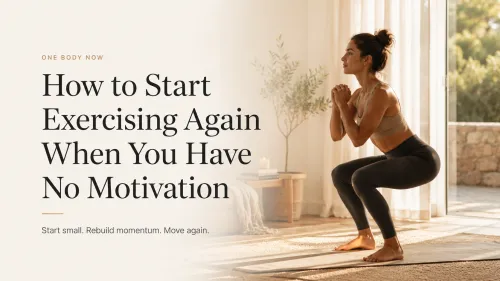
You wake up, check the plan, and feel the gap immediately. Yesterday, the workout looked realistic. Maybe even inviting. A full session before work, a class after lunch, a run at the end of the day, or a strength routine you promised yourself you would not skip again. But this morning, your body feels heavy. Your mind is already full. Your energy is not bad enough to call it a rest day with confidence, but it is nowhere near the version of you who made the plan.
This is where many movement routines quietly begin to break. Not because people are lazy. Not because they lack discipline. Often, it happens because the plan has only two settings: do the full workout or do nothing. Force it or fail. Push through or feel guilty.
But movement on low energy days does not have to look like your best day. It does not need to be intense, long, impressive, or even particularly structured. A gentler version still counts. A five-minute walk still counts. A slow stretch while coffee brews still counts. A lighter session that respects your current energy still supports the larger habit.
Right now, this matters because modern work has made many people more mentally tired, more sedentary, and more disconnected from natural movement. Hybrid days blur boundaries. Screens absorb hours. The pressure to be productive can turn fitness into another performance task. For people trying to build sustainable fitness habits, the skill is not only learning how to train harder. It is learning how to adjust.
In this guide, you will learn how to move when you are tired without turning movement into another source of pressure.
What you will learn:
- Why the all-or-nothing mindset makes movement routines harder to sustain.
- How to reframe a low energy workout as a valid part of consistency.
- How to match movement to your actual energy, not yesterday’s ambition.
- Gentle movement ideas for very low, low, and moderate energy days.
- How scaling down can help you avoid burnout and stay connected to your routine.
- A simple 7-day framework for moving your body without forcing intensity.
- Practical micro-moments you can use during real working days.
Consistency does not mean intensity. Sometimes the most important rep is simply returning.
Why Movement on Low Energy Days Matters More Than You Think
Movement on low energy days matters because these are the days that reveal whether your routine is built for real life or only for ideal conditions. Most people can move when sleep was good, the schedule is clear, motivation is high, and the playlist hits perfectly. The harder question is what happens on the tired Tuesday, the foggy Friday, the day after travel, the afternoon after back-to-back meetings, or the morning when you feel emotionally flat.
These moments are not exceptions. They are part of the pattern. If your routine cannot adapt to them, it will eventually feel fragile. If it can adapt, it becomes something more reliable: a relationship with movement that does not depend on being at your best.
The common low-energy moment
Imagine this: you planned a 45-minute workout before work. Your clothes are ready. The app is open. But your body feels slower than expected. You slept, but not deeply. You are not unwell, just drained. The first thought is often, “I should still do it.” The second thought is, “I really cannot.” Then comes the guilt, the bargaining, and sometimes the quiet decision to skip movement entirely.
This pattern is familiar because so much of fitness culture rewards intensity. Progress is often shown through heavier weights, longer runs, harder sessions, faster splits, or visible transformation. There is nothing wrong with challenge when your body is ready for it. But if challenge becomes the only definition of success, low-energy days start to feel like personal failure.
The real opportunity: staying connected
On low-energy days, the goal may not be performance. It may be connection. You are reminding your body, your calendar, and your identity that movement belongs in your life even when it changes shape.
That shift is subtle but powerful. A reduced session keeps the thread intact. It says, “I am still someone who moves, even when I adapt.” This kind of self-trust is often what makes routines last longer than bursts of motivation.
What the research suggests about consistency
Public health guidance from organizations such as the World Health Organization recognizes that physical activity can accumulate across the week, and that both moderate and vigorous movement can contribute to health-supportive routines. Many movement researchers and coaches also emphasize adherence, which simply means the ability to keep showing up over time. In practice, a routine people can repeat usually matters more than a routine they can only tolerate for two weeks.
That does not mean every small walk replaces structured training. It means small, adaptable movement has a place inside a bigger pattern. Gentle movement ideas can act as a bridge between rest and a full workout, especially when the alternative is doing nothing and feeling disconnected.
A practical takeaway
Before deciding whether a low-energy day is a failure, ask a better question:
- What version of movement would feel respectful today?
- What would help me feel a little more present in my body?
- What can I do without borrowing energy from tomorrow?
When you answer those questions honestly, movement becomes less about proving yourself and more about supporting yourself. That is the foundation for everything that follows.
The All-or-Nothing Mindset That Quietly Breaks Movement Routines
The all-or-nothing mindset sounds disciplined at first. It says, “If I am going to exercise, I should do it properly.” The problem is hidden inside the word “properly.” For many people, properly means the full workout, the exact duration, the perfect conditions, the planned intensity, and the feeling of having earned it. Anything less becomes a disappointment.
This mindset is one of the most common reasons people lose consistency. Not because they are unwilling to move, but because their definition of movement is too narrow.
How the cycle begins
The cycle usually starts with good intentions. You create a plan. You feel motivated. You commit to a routine that reflects the person you want to become. Then life arrives. A long workday. A poor night of sleep. A delayed train. A demanding family morning. A week of meetings that leaves your body still and your mind overstimulated.
At that point, the plan asks for more energy than you have. If there is no lighter option, the choice becomes uncomfortable:
- Force the full workout and risk feeling depleted.
- Skip the session and feel like you failed.
- Promise to restart tomorrow, then repeat the same pattern later.
Over time, this can create emotional friction around movement. A workout becomes not just a physical task, but a test of identity. If you complete it, you are disciplined. If you do not, you are behind. That pressure may work briefly, but it rarely feels sustainable.
Why perfection is not the same as consistency
Perfection is rigid. Consistency is responsive. Perfection needs everything to happen according to plan. Consistency understands that the plan may need to bend.
A person with a perfection-based routine might miss a workout and think, “The week is ruined.” A person with a consistency-based routine might think, “Today becomes a walk and some mobility. Tomorrow I reassess.” The second person is not less committed. They are more adaptable.
This matters because most people do not quit movement in one dramatic moment. They drift away through repeated small disappointments. Each skipped session adds a little distance. Each guilt-heavy restart makes the habit feel harder. Eventually, movement begins to feel like something that belongs to an ideal version of life, not the life they are actually living.
A real-world example: the hybrid worker
Consider a People & Culture leader in London or Paris who spends most of the day between calls, performance conversations, strategy documents, and Slack messages. She planned to do a 30-minute workout after work. By 18:30, her brain is tired, her shoulders are tense, and her motivation has disappeared.
The all-or-nothing mindset says, “If you cannot do the full session, you failed.” A sustainable approach says, “You are tired. What movement would help you transition out of work?” That might be a ten-minute walk, a slow hip and shoulder mobility flow, or three rounds of gentle bodyweight movements. The session changes, but the habit remains alive.
How to loosen the all-or-nothing grip
Try replacing binary rules with flexible minimums:
- Instead of “I must do 45 minutes,” choose “I will begin with five.”
- Instead of “I must sweat,” choose “I will move with attention.”
- Instead of “I missed the workout,” choose “I scaled the workout.”
- Instead of “Tomorrow I restart,” choose “Today I stay connected.”
This is not lowering standards. It is building a routine that can survive normal life. Once you stop treating low-energy movement as failure, you create space for a more intelligent and compassionate form of consistency.
Low-Energy Movement Is Still Movement, Not a Failure
One of the most important reframes in sustainable fitness habits is this: a gentler session is not a failed session. It is a different session. When your energy is low, adjusting intensity is not quitting. It is listening, choosing, and staying in relationship with your body.
Many people know how to push. Fewer people know how to scale down without turning it into shame. But scaling down is a skill. It requires self-awareness, patience, and trust that small movements still matter.
What counts as movement?
Movement is not limited to a gym workout or a formal class. It includes walking, stretching, mobility, light bodyweight exercises, balance work, gentle cycling, easy swimming, standing up between calls, taking the stairs slowly, or moving through a few positions on a mat.
On high-energy days, movement might be structured and progressive. On low-energy days, movement might be short and restorative. Both belong in a complete routine.
Examples of valid low-energy movement include:
- A slow ten-minute walk around the block.
- Five minutes of neck, shoulder, and spine mobility.
- A gentle bodyweight flow with squats, wall push-ups, and step-backs.
- Stretching calves, hips, and back after a long day at a desk.
- A shorter version of your usual session at a lower pace.
None of these need to be dramatic to be useful. The value is partly physical and partly behavioral. You are practicing the act of returning.
The difference between rest and avoidance
A common question is whether low energy means you should rest or move. The answer depends on the day. Sometimes rest is the wise choice. Sometimes gentle movement helps you feel more grounded, less stiff, and more present. The key is learning the difference between genuine need for rest and avoidance driven by overwhelm.
Here is a simple distinction:
- Rest may be appropriate when you feel unusually exhausted, unwell, dizzy, in pain, or clearly under-recovered.
- Gentle movement may be appropriate when you feel tired but capable of easy motion, especially if you have been sitting for hours.
- A scaled workout may be appropriate when your body feels okay but your motivation or mental energy is low.
This is not a medical rule. It is a practical reflection tool. When in doubt, choose the most respectful option and keep intensity low.
Why small sessions help identity
Habits are not only built by outcomes. They are built by repeated evidence. Each time you move, even briefly, you give yourself evidence that movement belongs to your day. That evidence matters.
A low energy workout might not create the same training stimulus as your full session, but it can protect the rhythm of the habit. It keeps the doorway open. The next session feels less like starting again and more like continuing.
Language that changes the experience
The words you use after a low-energy session matter. Compare these two statements:
- “I only walked for ten minutes.”
- “I chose a ten-minute walk because that matched my energy today.”
The movement is the same. The meaning is different. One sounds like disappointment. The other sounds like self-leadership.
On low-energy days, the goal is not to pretend you feel amazing. It is to meet the day honestly and still choose one helpful action.
How to Match Movement to Energy Instead of Forcing a Fixed Plan
A fixed plan can be useful. It removes decision fatigue, gives structure, and helps you build progression over time. But a fixed plan becomes a problem when it ignores the state of the person doing it. Your body is not a machine that performs the same way every day. Energy changes with sleep, stress, workload, travel, cycle, mood, recovery, and life demands.
Matching movement to energy is the practice of keeping the intention while adjusting the expression. You still move, but you choose the version that fits today.
The energy check-in
Before moving, pause for thirty seconds. You do not need a complicated scorecard. Simply ask:
- How heavy or light does my body feel?
- How clear or foggy does my mind feel?
- Do I feel stiff from stillness or depleted from effort?
- Would movement give me energy, or would it take too much today?
- What is the smallest useful version of the plan?
A few slow breaths while standing, walking, or sitting can help create enough space to answer honestly. Not as a performance ritual, but as a moment of attention before you choose.
Use a traffic-light system
A simple traffic-light system can make decisions easier:
- Green day: Energy is good. Follow the planned workout, or train normally.
- Amber day: Energy is mixed. Reduce duration, load, speed, or complexity.
- Red day: Energy is very low. Choose gentle movement or full rest.
This helps you avoid treating every day as either perfect or pointless. Most real days are amber. They ask for adjustment, not abandonment.
Adjust the four main levers
When you want to exercise without burnout, you can modify four simple variables:
- Duration: Reduce a 45-minute session to 20 minutes, or a 20-minute session to five.
- Intensity: Move slower, use lighter resistance, or keep effort conversational.
- Complexity: Choose familiar movements instead of technical ones.
- Environment: Move at home, outside, or near your desk instead of traveling to a gym.
Often, one adjustment is enough. If your body feels okay but time is short, reduce duration. If your body feels heavy, reduce intensity. If your mind is tired, reduce complexity. If leaving the house feels like the barrier, change the environment.
A real-world example: the planned run
You planned a 40-minute run. At the end of the day, you feel drained. Instead of canceling automatically, you scale:
- Option 1: Walk for 20 minutes.
- Option 2: Jog for ten minutes, then walk home.
- Option 3: Do a gentle mobility sequence and go to bed earlier.
All three choices are more intelligent than forcing the original plan without checking in. They also preserve your relationship with movement. You are not negotiating with guilt. You are responding to reality.
The power of the “minimum viable movement”
Minimum viable movement is the smallest amount of movement that keeps the habit alive and feels supportive. It might be two minutes. It might be ten. It might be one slow lap around the block.
This minimum is not meant to replace every workout. It is meant to protect consistency on days when the full routine is not realistic. Once you begin, you may choose to continue. But the win is not doing more. The win is beginning without pressure.
Gentle Movement Ideas by Energy Level
When you are tired, too many options can make movement feel harder. This reference block gives you simple choices based on how much energy you actually have. Use it as a menu, not a rulebook. Choose one option, make it easier if needed, and stop while it still feels respectful.
Very low energy
Choose this level when your body feels heavy, your mind is tired, or the idea of a workout feels impossible but a tiny amount of movement feels accessible.
- Short walk: Walk for three to ten minutes, indoors, outside, or even around your building.
- Slow stretch: Choose two or three areas, such as neck, shoulders, hips, or calves, and move gently.
- Floor reset: Lie on a mat, bend your knees, and slowly rock them side to side.
- Desk release: Stand up, roll your shoulders, reach overhead, and turn slowly from side to side.
- A few slow breaths while moving: Walk slowly and let your breathing settle naturally as you move.
Low energy
Choose this level when you feel tired but not depleted. You may not want intensity, but you can imagine moving for ten to twenty minutes.
- Light mobility: Move through gentle circles for ankles, hips, spine, shoulders, and wrists.
- Easy walk: Walk at a pace where you could comfortably hold a conversation.
- Gentle bodyweight flow: Try sit-to-stands, wall push-ups, slow lunges, and relaxed stretching.
- Low-impact home session: Step side to side, reach, hinge, squat to a chair, and repeat slowly.
- Music-led movement: Put on one calm song and move however feels natural until it ends.
Moderate energy
Choose this level when you have some energy but not enough for the full plan. This is the ideal place to shorten or simplify your usual routine.
- Shorter version of your usual workout: Do half the time, half the rounds, or fewer exercises.
- Reduced-intensity strength session: Use lighter weights, slower reps, and longer rest.
- Walk-jog or easy cycle: Keep effort comfortable and finish feeling like you could do a little more.
- Technique practice: Focus on form rather than intensity.
- One-round circuit: Complete one gentle round of your usual warm-up and main movements.
How to choose without overthinking
If you are unsure, begin one level lower than you think. Very often, the first few minutes reveal whether your body wants more or less. You can always add. You do not need to prove anything at the start.
A helpful rule is: finish feeling better than when you began, or at least not worse. On low-energy days, that is enough.
Permission to Scale Down Can Prevent Burnout and Protect Consistency
Many people believe they need more discipline, when what they actually need is more permission to adapt. Permission is not the opposite of commitment. It is what allows commitment to continue through changing circumstances.
When movement only counts at high intensity, people often push past their available energy until the routine becomes emotionally expensive. Eventually, the body or the schedule pushes back. A week gets missed. Then another. The person returns with renewed pressure and repeats the same pattern. This is the all-or-nothing cycle in motion.
Scaling down is a protective strategy
Scaling down can help reduce the pressure that turns movement into a source of stress. It may also support long-term consistency because the routine becomes easier to maintain across different energy states. The key is to scale intentionally, not disappear accidentally.
For example, if your planned workout is:
- Five exercises for four rounds, scale to three exercises for two rounds.
- A 60-minute class, scale to a 20-minute home session.
- A run with intervals, scale to an easy walk-jog.
- A gym session, scale to mobility and a short walk near home.
Each scaled version keeps the movement identity alive. You still showed up. You still made a choice. You still honored the intention.
Why this helps with exercise without burnout
Burnout is not only about doing too much physically. It can also come from constantly asking yourself to override signals, ignore context, and meet unrealistic expectations. When every workout becomes another demand, even healthy intentions can start to feel heavy.
Exercise without burnout means building a movement practice that includes challenge, but also includes recovery, ease, and flexibility. It means understanding that your capacity changes. It means not treating every low-energy day as a character flaw.
This is especially important for people with demanding work lives. If you spend the day making decisions, solving problems, leading teams, or absorbing emotional labor, your nervous system and attention may already feel loaded. A punishing workout might not be what you need that day. A gentle session might be the bridge back to yourself.
Use the “protect tomorrow” question
Before forcing a workout when tired, ask:
Will this choice support tomorrow, or steal from it?
Sometimes the answer will be, “I can train, but lighter.” Sometimes it will be, “I need a walk and an early night.” Sometimes it will be, “Once I warm up, I feel fine.” The point is not to avoid effort. The point is to choose effort wisely.
A cautious view of progress
Progress is not always more. Sometimes progress is learning to stop at the right time. Sometimes it is recognizing that a fifteen-minute session is better for your week than a forced hour that leaves you resentful. Sometimes it is building trust that you can adjust without abandoning the habit.
For long-term consistency, the routine that bends often lasts longer than the routine that breaks.
Small Anchors and Daily Cues That Make Movement Easier
On low-energy days, motivation is unreliable. Cues are more dependable. A cue is a small signal that tells your body and mind, “This is when I move.” It removes some of the decision-making and helps movement become part of the rhythm of your day.
Small anchors are especially useful because they do not require a full reset. They attach movement to something already happening: coffee, lunch, commuting, a meeting ending, changing clothes, brushing teeth, or closing a laptop.
Why anchors work
A large goal asks for energy. A small anchor asks for recognition. You do not need to ask, “Do I feel motivated to move today?” You simply notice, “Lunch is finished, so I walk for five minutes.” The cue carries the habit until motivation returns.
This is one reason small daily actions can be so effective. They reduce the emotional weight of starting. And on low-energy days, starting is often the hardest part.
Examples of movement anchors
- After coffee starts brewing: Do slow calf raises, shoulder circles, or a gentle forward fold.
- After your first meeting: Stand up and walk for two minutes before checking messages.
- After lunch: Take a five-minute walk, even if it is just around the block.
- Before opening your laptop: Do five slow sit-to-stands from a chair.
- When the workday ends: Change into comfortable clothes and take one slow lap outside.
- Before bed: Stretch your hips, back, or shoulders for three minutes.
The “same cue, different dose” method
The beauty of anchors is that the cue can stay the same while the movement changes. For example, after lunch can always be your movement moment. On a high-energy day, it might be a brisk 20-minute walk. On a low-energy day, it might be five minutes in fresh air. On a very low-energy day, it might be standing outside and gently moving your neck and shoulders.
The cue remains stable. The dose adapts.
A workplace example
In a hybrid team, many employees finish meetings and immediately drop into the next tab, next call, or next message. Over time, the body spends hours in stillness while the mind stays alert. A simple cue, such as “move for two minutes after every long call,” can change the texture of the day without requiring a formal workout.
It might look like:
- Walking to refill water.
- Standing near a window and stretching the chest.
- Doing five chair squats.
- Taking stairs slowly between floors.
- Walking outside before the next block of focused work.
This is not about optimizing every minute. It is about building gentle reminders that your body is part of the workday, not something you return to only after hours.
How One Body Now fits naturally
A movement companion can make anchors easier because it gives you options when your mind is too tired to invent them. One Rep Now is designed around moving anywhere and building the habit, which makes it especially useful when the question is not “How do I crush a workout?” but “What version of movement fits today?”
The more your routine includes small, repeatable anchors, the less you need to rely on willpower alone.
Practical Micro-Moments for Real Working Days
Most people do not need more abstract advice. They need movement that fits between meetings, family responsibilities, commutes, deadlines, social plans, and the quiet fatigue of everyday life. Micro-moments are small pockets of movement that meet you where you are. They are not glamorous, but they are often the difference between staying connected and drifting away.
Micro-moments are particularly helpful for movement on low energy days because they lower the barrier to entry. You are not asking yourself to transform the day. You are asking for one small action.
The five-minute walk after lunch
A five-minute walk after lunch is one of the simplest anchors available. It requires no equipment, no change of clothes, and no special setting. It can be slow. It can be indoors. It can be a loop around the office, courtyard, or street.
The purpose is not to achieve a training effect. The purpose is to interrupt stillness, reset attention, and remind your body that movement can be ordinary. If five minutes feels too small to matter, that is exactly why it is useful. It is small enough to repeat.
Gentle stretching while coffee brews
Coffee brewing creates a natural pause. Instead of filling it with scrolling, use it as a movement cue. Try:
- Ten slow shoulder rolls.
- A gentle side bend on each side.
- Five slow calf raises.
- A relaxed forward fold with bent knees.
- Slow neck turns, without forcing range.
This takes less than three minutes. It does not need to look like exercise. It is simply a way to begin the day inside your body rather than only inside your thoughts.
A slow lap around the block after a hard day
After work, the body often carries the shape of the day: tight hips, rounded shoulders, shallow attention, and mental residue from unfinished tasks. A slow lap around the block can become a transition ritual. It marks the end of work and the beginning of personal time.
On low-energy days, do not make it brisk unless that feels good. Let it be easy. Notice the light, the pavement, the air, the shift in posture. Movement can be a boundary, not another demand.
The two-minute meeting reset
Between calls, try a two-minute reset:
- Stand up.
- Reach both arms overhead.
- Step side to side ten times.
- Roll shoulders slowly.
- Walk away from the screen and back.
This is especially valuable on days when a full workout is unlikely. You are still giving your body movement across the day, not waiting for one perfect window that may never arrive.
The evening floor sequence
If you feel too tired for standing movement, go to the floor. Try a gentle sequence:
- Knees side to side for one minute.
- Child’s pose or relaxed forward reach for one minute.
- Cat-cow movements for one minute.
- Seated side bends for one minute.
- Stillness for one minute before getting up slowly.
This is a low energy workout in the softest sense. It is not about effort. It is about returning to your body at the end of the day.
Rest vs Movement: How to Decide Without Guilt
One of the most searched questions around how to exercise when tired is whether tiredness means you should rest or move. The honest answer is: it depends. The better skill is learning to decide without guilt.
Rest and movement are not enemies. They are both part of a sustainable routine. Some days, rest is the most supportive choice. Other days, gentle movement is exactly what helps you feel less stuck. The challenge is separating your body’s needs from the noise of expectation.
Signs that rest may be the better choice
You may want to choose rest, or seek appropriate guidance if needed, when you notice:
- Unusual exhaustion that does not improve after warming up gently.
- Feeling unwell or clearly run down.
- Pain that changes your movement or feels sharp.
- Dizziness, nausea, or symptoms that feel concerning.
- A strong sense that movement would be forced rather than supportive.
This guide is not a substitute for professional advice. If something feels unusual or worrying, it is always sensible to listen and get support.
Signs that gentle movement may help
Gentle movement may be worth trying when:
- You feel stiff from sitting but not truly depleted.
- Your mind is tired but your body feels capable of easy movement.
- You feel low motivation but no clear reason to avoid movement.
- You want a transition between work and rest.
- You suspect starting small will feel better than staying still.
In these cases, begin with five minutes. Give yourself permission to stop. The permission is important because it removes the pressure that often makes starting feel impossible.
The five-minute test
The five-minute test is simple:
- Choose a very easy movement, such as walking or mobility.
- Move for five minutes at low intensity.
- Check how you feel.
- If you feel better or neutral, continue gently if you want.
- If you feel worse, stop and rest without guilt.
This gives you information without demanding a full commitment. It also trains trust. You learn that you can begin, assess, and choose, rather than obeying a rigid rule.
Let rest be clean
If you choose rest, let it be clean. Clean rest means you do not spend the whole evening mentally punishing yourself for not exercising. You made a decision. You can return tomorrow. Guilt is not movement. It does not build strength, mobility, or consistency. It only makes the next choice feel heavier.
A clean rest day might include ordinary movement: walking to the shop, stretching lightly, or standing outside for a few minutes. Or it might include no intentional movement at all. What matters is that you do not turn rest into a moral problem.
A Simple 7-Day Low-Effort Movement Framework
A low-energy week does not have to become a lost week. The goal of this 7-day framework is to give you one small movement idea per day, each adaptable to your energy level. Use it during busy work periods, after travel, during emotionally demanding weeks, or anytime your usual routine feels too heavy.
This is not a challenge. It is a support structure. You can repeat days, skip intensity, shorten everything, or turn any day into rest if needed.
Day 1: The five-minute walk
Walk for five minutes at any pace. If energy is very low, walk indoors or around your home. If energy is moderate, extend to fifteen or twenty minutes. The aim is to begin the week with ease.
Day 2: The coffee stretch
While coffee or tea brews, move through shoulder rolls, side bends, calf raises, and a gentle forward fold. Keep everything slow. If you want more, add a short walk later in the day.
Day 3: The desk mobility reset
Between meetings or tasks, take two minutes to stand, reach, rotate gently, and walk away from the screen. Repeat once or twice if it feels useful. This is ideal for screen-heavy days.
Day 4: The shorter version
Take your usual workout and cut it in half. Half the time, half the rounds, or half the exercises. Keep the movements familiar. Finish before you feel drained.
Day 5: The slow strength flow
Do one to three gentle rounds of sit-to-stands, wall push-ups, step-backs, and light stretching. Move slowly. Rest often. Make it feel like practice, not punishment.
Day 6: The outdoor reset
Take a relaxed walk outside. If you are very tired, make it one slow lap around the block. If you have more energy, walk longer but keep the pace comfortable.
Day 7: The floor release
End the week with five to ten minutes on the floor. Move your knees side to side, stretch hips gently, lengthen the back, and rise slowly. If rest feels better, let this day be full rest.
How to adapt the week
Use a simple scale:
- Very low energy: Do the smallest version, one to five minutes.
- Low energy: Do the suggested version, five to fifteen minutes.
- Moderate energy: Add time, one extra round, or a slightly brisker pace.
If you want guided movement options that match real days rather than perfect ones, One Body Now can act as a calm companion for building from one action now.
Expert Tips and Pro Strategies for Moving When You Are Tired
Once you understand the basics of listening to your body movement, the next step is learning how to make low-energy movement practical under pressure. These strategies are useful for people who already value movement but struggle with consistency during demanding weeks.
Use a Plan A, Plan B, Plan C structure
Instead of writing one workout into your schedule, create three versions:
- Plan A: Full workout for good-energy days.
- Plan B: Shorter workout for mixed-energy days.
- Plan C: Minimum movement for very low-energy days.
For example:
- Plan A: 40-minute strength session.
- Plan B: 20-minute strength session with fewer sets.
- Plan C: Five minutes of mobility and a short walk.
This removes the emotional drama from scaling down. You are not improvising a failure. You are following the correct plan for the day.
Make the first move almost too easy
When tired, the first movement should feel simple enough that you cannot argue with it. Put on shoes. Stand on the mat. Walk to the end of the street. Do one slow stretch. The goal is to cross the starting line with minimal resistance.
After that, you can decide whether to continue. Many people find that once the body begins, the mind softens. But even if you stop after the first small action, you have still reinforced the habit.
Avoid these common mistakes
- Mistake 1: Turning every tired day into a test of discipline. Some tired days call for effort. Some call for gentleness.
- Mistake 2: Scaling down but criticizing yourself the whole time. The emotional tone matters. Let the lighter session count.
- Mistake 3: Choosing complex workouts when your mind is exhausted. Low mental energy usually needs simple movement.
- Mistake 4: Waiting until late evening to decide. If evenings are hard, anchor small movement earlier.
- Mistake 5: Confusing consistency with sameness. A consistent routine can include different intensities.
Build a low-energy movement library
Create a short list of movements you can do without thinking. Keep it visible in your notes app, calendar, or near your workspace. Include options for walking, mobility, stretching, and simplified strength. When energy is low, decision-making becomes harder. A prepared library reduces friction.
Track completion, not intensity
If you track movement, consider marking whether you showed up rather than only how hard you trained. This protects the value of gentle days. You can still track duration, steps, or workouts if you enjoy data, but do not let numbers erase the importance of adaptability.
Use premium simplicity
The best low-energy routines are often elegant in their simplicity. A mat. A walk. A familiar sequence. A timer. Comfortable clothing. No unnecessary complexity. For more movement ideas and practical reflections, you can explore The Journal, where the focus is on sustainable daily practice rather than pressure.
Step-by-Step Checklist: How to Move on a Low-Energy Day
Use this checklist the next time your planned workout feels too much. It is designed to help you choose movement without guilt, pressure, or overthinking.
- Pause before deciding.
Take thirty seconds. Notice whether you feel depleted, stiff, mentally tired, or simply unmotivated. Pro tip: do not make the decision while criticizing yourself. - Name your energy level.
Choose very low, low, moderate, or good. Pro tip: if you are unsure, choose the gentler category first. - Select the right version.
Very low may mean stretching or a short walk. Low may mean mobility or an easy flow. Moderate may mean a shorter usual session. Pro tip: reduce duration before removing movement completely. - Set a tiny starting point.
Commit to two to five minutes. Pro tip: the aim is not to trick yourself into more. The aim is to make beginning safe and simple. - Move gently.
Keep effort comfortable. Avoid complex exercises if your mind is tired. Pro tip: choose movements you already know well. - Reassess after five minutes.
If you feel better, continue if you want. If you feel worse, stop. Pro tip: stopping after an honest check-in is still a successful decision. - Let it count.
Do not finish by saying, “That was nothing.” Pro tip: use language that reinforces consistency, such as “I matched movement to my energy today.”
Conclusion: Small Movement Still Builds the Routine
Moving your body on low-energy days is not about lowering your ambition. It is about building a movement practice that can live inside real life. Some days will invite challenge. Some days will ask for patience. Both can belong to the same consistent routine.
Key takeaways:
- Movement on low energy days is still movement.
- Consistency does not require the same intensity every day.
- Scaling down can protect your routine from the all-or-nothing cycle.
- Small anchors, such as walks after lunch or stretches while coffee brews, make movement easier to repeat.
- Rest and movement both have a place. The skill is choosing without guilt.
The next time the planned workout feels impossible, do not jump straight to forcing it or skipping everything. Ask what version fits the day. Maybe it is five minutes. Maybe it is a shorter session. Maybe it is rest. The point is to stay honest, kind, and connected.
Some days ask for more. Some days ask for less. Both still count. One Body Now helps you build from there.
Frequently Asked Questions
What is the best movement on low energy days?
The best movement on low energy days is the version you can do without feeling pressured or depleted. For many people, that means a short walk, gentle stretching, light mobility, or a simplified bodyweight flow. The goal is not to complete an intense workout. It is to stay connected to movement in a way that matches your current energy. If you feel very tired, start with two to five minutes and reassess. If you feel better, continue gently. If you feel worse, stop and rest without guilt.
How do I exercise when tired without overdoing it?
To exercise when tired, reduce one or more variables: duration, intensity, complexity, or environment. For example, turn a 45-minute workout into 15 minutes, use lighter resistance, choose familiar movements, or move at home instead of going to the gym. Begin with a five-minute test and keep the effort comfortable. You should feel able to stop at any time. This approach helps you practice listening to your body movement rather than forcing a plan that no longer fits the day.
Is a low energy workout still worth it?
Yes, a low energy workout can still be worth it, especially when the goal is consistency rather than intensity. A gentle session may not feel impressive, but it helps reinforce the habit of showing up. It can also reduce the emotional gap between “training” and “doing nothing.” A short walk, a few mobility movements, or a lighter version of your usual routine can keep the thread of your practice intact. Over time, that adaptability is often what makes movement sustainable.
Should I rest or move when I feel tired?
It depends on the type of tiredness. If you feel unwell, unusually exhausted, dizzy, in pain, or clearly under-recovered, rest may be the better choice. If you feel mentally tired, stiff from sitting, or low in motivation but physically capable, gentle movement may help you reconnect with your body. A useful approach is the five-minute test: move very gently for five minutes, then reassess. If movement feels supportive, continue. If it does not, stop and let rest be clean.
Can gentle movement help build sustainable fitness habits?
Gentle movement can support sustainable fitness habits because it keeps movement accessible on days when a full workout feels unrealistic. Many routines fail because they only allow for high-effort sessions. When you create smaller options, you reduce the chance of skipping entirely and feeling guilty. Gentle movement also helps build identity: you become someone who moves in different ways, not only under perfect conditions. This flexibility can make your routine easier to maintain across busy, stressful, or low-energy periods.
What are some gentle movement ideas for very low energy?
For very low energy, keep movement simple and brief. Try a three-minute walk, slow shoulder rolls, gentle neck turns, a relaxed forward fold with bent knees, or lying on the floor with knees rocking side to side. You can also stand near a window and shift weight from foot to foot. The goal is not to exercise hard. It is to create a small moment of connection with your body. Choose movements that feel easy, familiar, and non-demanding.
How long should I move on a low-energy day?
On a low-energy day, even two to ten minutes can be enough to keep the habit alive. If you have slightly more energy, aim for ten to twenty minutes of easy walking, mobility, or a shorter version of your usual workout. The duration should match your capacity, not an arbitrary standard. Start small and reassess. If you feel better after five minutes, you can continue. If you feel more tired, stop. The right length is the one that supports today without stealing from tomorrow.
What if I feel guilty for not doing my planned workout?
Guilt often appears when your plan only has two options: complete the full workout or fail. Try reframing the moment. You did not fail if you chose a version that matched your energy. You scaled the plan. Use language that reinforces the choice, such as “I moved gently today because that is what my body needed.” This matters because shame can make future movement feel heavier. A flexible routine allows you to stay consistent without turning every tired day into a personal judgment.
Can I replace a workout with walking?
Sometimes, yes. Walking can be a useful replacement when your planned workout feels too intense for your current energy. It may not serve the exact same purpose as strength training, intervals, or a class, but it can still support consistency and daily movement. Think of walking as a bridge, not a downgrade. On low-energy days, a walk can help you maintain the habit while respecting your limits. On higher-energy days, you can return to more structured training.
How do I know if I am avoiding movement or genuinely need rest?
Ask what kind of tired you feel. If your body feels unwell, unusually depleted, or in pain, rest may be wise. If your body feels capable but your mind is resisting because the workout seems too big, you may need a smaller movement option rather than full rest. Try the five-minute test with very gentle movement. If you feel more present or neutral, continue lightly. If you feel worse, rest. Over time, this helps you build trust in your own signals.
What is the all-or-nothing cycle in fitness?
The all-or-nothing cycle happens when a person believes movement only counts if it matches the full plan. They train hard when conditions are good, then skip entirely when energy, time, or motivation drops. This often leads to guilt, restarts, and inconsistency. A more sustainable approach includes flexible versions of movement: full workouts, shorter workouts, gentle movement, and rest. When all of these are allowed, low-energy days no longer break the routine. They simply change the form of it.
How can I make low-energy movement easier to start?
Make the first step very small. Put on comfortable shoes, stand on the mat, walk for two minutes, or do one stretch while coffee brews. Attach movement to an existing cue, such as after lunch, after a meeting, or when you close your laptop. You can also prepare a low-energy movement menu in advance so you do not need to decide when tired. The easier the start, the more likely you are to stay connected without relying on motivation.
Does consistency mean moving every single day?
Consistency does not have to mean formal exercise every single day. It means returning regularly in a way that supports your life and goals. Some days may include a full workout. Some may include walking or mobility. Some may include rest. The important part is that you do not let one low-energy day become a reason to abandon the whole routine. Sustainable consistency is flexible, realistic, and kind enough to continue through imperfect weeks.
What should I do if my energy is always low?
If your energy feels consistently low, it may be worth looking beyond your workout plan and seeking appropriate professional support if needed. From a movement perspective, keep sessions gentle, short, and pressure-free. Walking, mobility, and light stretching may feel more accessible than intense training. Avoid using exercise as another demand on an already depleted system. The goal is to build a supportive rhythm, not to force performance. If low energy is persistent or concerning, listen to your body and consider speaking with a qualified professional.
Quotes for “Moving Your Body on Low-Energy Days”
“Movement is life. Life is a process. Improve the quality of the process and you improve the quality of life itself.”- Moshe Feldenkrais, movement educator and creator of the Feldenkrais Method“Exercise is the most transformative thing that you can do for your brain today.”- Dr. Wendy Suzuki, neuroscientist and author of Healthy Brain, Happy Life“As long as you are breathing, there is more right with you than wrong with you, no matter what is wrong with you.”- Jon Kabat-Zinn, mindfulness teacher and author of Full Catastrophe Living“You do not rise to the level of your goals. You fall to the level of your systems.”- James Clear, author of Atomic Habits“An early-morning walk is a blessing for the whole day.”- Henry David Thoreau, author and naturalist
Book Recommendations
- The Joy of Movement by Kelly McGonigal
A science-backed exploration of how movement improves mood, connection, resilience, and meaning. This is especially useful for reframing exercise as something that can feel good, not another task to “perform.” - Atomic Habits by James Clear
A practical guide to building tiny, sustainable habits. Great for low-energy days because it encourages small actions, identity-based habits, and systems that make movement easier to start. - Move Your DNA by Katy Bowman
Encourages a broader view of movement beyond workouts. Bowman explains how everyday actions- walking, stretching, squatting, reaching, and changing positions- can support whole-body health. - Rest: Why You Get More Done When You Work Less by Alex Soojung-Kim Pang
A helpful read for anyone who feels guilty about taking it easy. It highlights the importance of recovery and can support a gentler approach to movement on tired days. - Full Catastrophe Living by Jon Kabat-Zinn
A foundational book on mindfulness-based stress reduction. It offers a compassionate framework for tuning into the body, breathing, and moving with awareness rather than forcing yourself through fatigue. - Healthy Brain, Happy Life by Wendy Suzuki
Written by a neuroscientist, this book explains how physical activity supports brain health, mood, memory, and energy. It’s a motivating pick for understanding why even gentle movement matters.