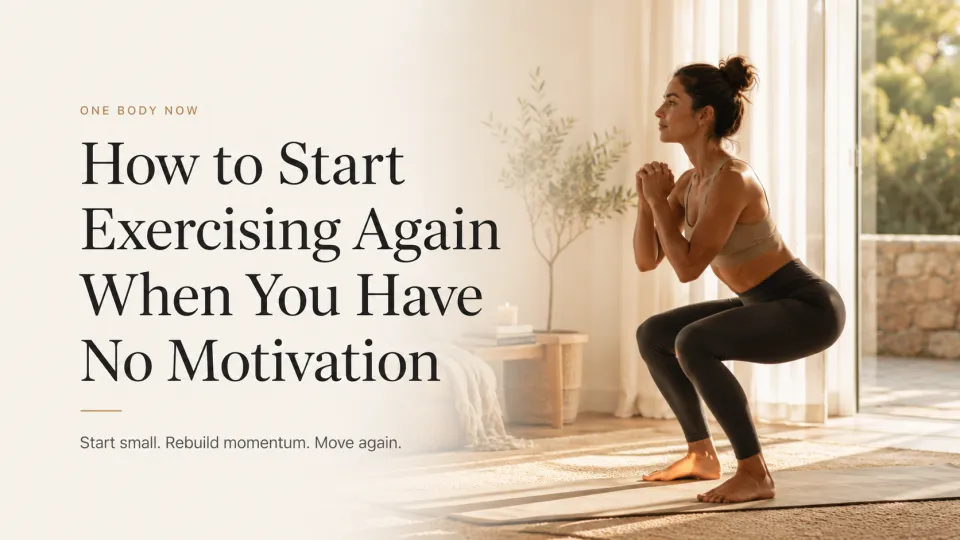
How to Start Exercising Again When You Have No Motivation
You are not lazy because you stopped exercising. You are probably tired, overloaded, out of rhythm, or carrying the quiet pressure of knowing you “should” move while not having the energy to begin.
That first step can feel strangely heavy. Not because your body is broken. Not because your character is weak. Often, it is because the idea of exercise has become too big. A workout sounds like changing clothes, finding time, choosing a plan, sweating, showering, tracking progress, and somehow feeling positive about all of it. When your motivation is low, that is not a small ask.
The better way to start exercising again is to make movement so small that your mind stops arguing with it. One stretch. One squat. One walk around the block. One repetition. One action now.
This guide is for anyone who wants to restart movement but feels tired, unmotivated, inconsistent, embarrassed, or overwhelmed. It is also for people who used to be active and now feel disconnected from their body. The aim is not to force discipline. It is to rebuild trust with movement.
What you will learn:
- Why motivation disappears and why that does not mean you are lazy
- How to start exercising again without relying on willpower
- Why tiny movements can rebuild momentum faster than ambitious plans
- How to use cues, environment, and recovery to make movement easier
- What to do when you feel tired, stressed, or embarrassed
- How to build a simple restart plan that fits real life
- How discreet tools like One Rep Now can help you move from intention to action without pressure
If you are returning after injury, illness, pregnancy, surgery, chronic health conditions, or if you have concerning symptoms such as chest pain, dizziness, unusual shortness of breath, or unexplained pain, seek advice from a qualified health professional before restarting exercise. For everyone else, the most useful place to begin is usually smaller than you think.
How to Start Exercising Again When You Have No Motivation: Reframe the Problem First
Before you create a workout plan, it helps to change the question. Most people ask, “How do I get motivated to exercise?” A better question is, “How do I make the first movement feel safe, simple, and possible?”
Motivation is unreliable. It rises when life feels manageable and disappears when sleep, stress, workload, mood, family demands, or self-criticism increase. If your plan depends on feeling inspired, it will probably collapse during a difficult week. That does not make you inconsistent. It means the plan was built on the least stable part of human behaviour.
The problem is often the size of the first step
When you have not exercised for a while, the word “exercise” can carry emotional weight. It may remind you of old routines, previous fitness levels, body changes, failed restarts, or comparison with other people. A twenty-minute workout might sound reasonable on paper, but in your nervous system it can feel like a mountain.
For example, Sophie, a busy People & Culture leader, might spend the whole day encouraging employee wellbeing while barely moving between video calls. At 7 p.m., she knows a workout would help. But she is tired, hungry, and mentally full. A full session feels impossible, so she does nothing. The next day, she feels guilty. The guilt makes exercise feel even heavier.
This loop is common:
- You decide you need a proper routine.
- The routine feels too demanding for your current energy.
- You delay starting until you feel more motivated.
- Waiting reduces momentum.
- Exercise begins to feel like proof that you are failing.
The way out is not to demand more discipline. It is to reduce the size of the promise.
Start with identity, not intensity
If your first goal is “get fit again,” the gap between where you are and where you want to be can feel discouraging. If your first goal is “become someone who moves today,” the task becomes much lighter.
You do not need to feel athletic to act like a person who moves. You only need one small movement that confirms the identity. A wall push-up. A slow shoulder roll. Five calf raises while the kettle boils. A two-minute walk after lunch.
Small actions matter because they reduce emotional friction. They also create evidence. Every tiny repetition tells your brain, “I can start.” That evidence is more useful than another plan you do not follow.
A practical reframe for today
Instead of asking, “Do I have the motivation to exercise?” ask:
“What is the smallest movement I can do without needing to change clothes, prepare, or negotiate with myself?”
That question moves you from pressure into action. It also prepares you for the next step: making movement so small that it becomes difficult to refuse.
Why Motivation Disappears, and Why It Is Not a Character Flaw
Low motivation is rarely random. It usually has a context. If you understand that context, you can design a gentler and more effective restart.
Many people stop exercising during busy work periods, major life changes, poor sleep, travel, illness, injury, grief, parenthood, burnout, or long stretches of screen-based work. Once the routine is broken, restarting requires more than physical effort. It requires decision-making, emotional energy, and self-trust.
Your brain prefers familiar patterns
The body tends to repeat what is familiar. If your recent pattern has been sitting, working late, scrolling, skipping movement, and telling yourself you will start Monday, that pattern becomes the path of least resistance. Not because it is ideal, but because it is known.
Exercise, especially after a break, asks the brain to spend energy on something uncertain. What workout should you do? Will it feel bad? Are you weaker now? Will you be sore tomorrow? What if you cannot keep it going?
These questions create friction. The more friction there is, the more motivation you need. The aim is to remove friction so motivation becomes less important.
Stress changes what feels possible
When you are stressed, your system often prioritises immediate relief. That might mean lying down, ordering food, checking messages, or avoiding anything that feels demanding. Even if movement would help, it can feel like another task.
This is why “just do it” advice is often unhelpful. It ignores the state of the person. A depleted person does not need a lecture. They need a lower entry point.
There is also a difference between physical tiredness and mental resistance. Sometimes your body is genuinely under-recovered and needs sleep, food, hydration, or rest. Other times, your body could move gently, but your mind is resisting the idea of a formal workout. Learning the difference is part of restarting intelligently.
The comparison trap makes restarting harder
If you used to exercise regularly, it can be painful to restart at a lower level. You may remember running 10 kilometres, lifting heavier weights, doing yoga every morning, or attending classes several times a week. Starting with one stretch can feel embarrassing.
But your previous fitness is not the entry requirement for your next movement. Your current reality is. A mature restart respects where you are now.
Try this practical reset:
- Remove “back to where I was” language. It adds pressure.
- Use “restart from here” language. It creates honesty.
- Track starts, not performance. Your first win is beginning.
- Choose movements that feel neutral. You do not need to love them yet.
A real-world example
Imagine someone who has not exercised for six months. They decide to restart with a 45-minute gym session. The session goes well enough, but they feel sore for three days. Work gets busy. They miss the next session. Then they decide they have failed again.
Now imagine the same person starts with three minutes every morning: ten bodyweight squats, ten wall push-ups, and one minute of walking around the flat. It feels almost too easy. But they do it five days in a row. By the end of the week, they no longer see themselves as someone who is “not exercising.” They see themselves as someone who has restarted.
That identity shift is small, but powerful. It leads naturally into the most important principle of this guide: make the first movement tiny.
The One-Movement Rule: Make the First Step Too Small to Fail
When motivation is low, the best movement plan is not the most impressive one. It is the one you will actually begin.
The one-movement rule is simple: choose one movement, perform one very small version of it, and stop if you want to. You are allowed to continue, but continuing is not required. The goal is to rebuild the habit of starting.
Why one movement works
A small movement lowers the mental cost of action. It removes the need for a full plan. It also creates a clean finish line. You are not committing to “exercise more.” You are committing to one specific action.
Examples include:
- One squat while waiting for coffee
- One slow forward fold after closing your laptop
- One wall push-up before a shower
- One minute of walking outside after lunch
- One set of shoulder circles between meetings
- One gentle hip stretch before bed
This may seem too small to matter. But the purpose is not to deliver a full fitness adaptation on day one. The purpose is to reduce avoidance. Once avoidance drops, consistency becomes possible.
One movement often becomes more
Most people have experienced this in another area of life. You tell yourself you will tidy one drawer, then clean the whole kitchen. You promise to answer one email, then finish three. Starting changes your state.
Movement works similarly. One squat may become five. A two-minute walk may become ten. A stretch may become a short mobility flow. But if you require ten minutes from the start, you may never begin.
The key is to let “more” be optional. Optional movement feels different from forced movement. It gives the body a sense of choice.
Choose movements with low setup
Your first movement should not require equipment, travel, special clothing, or perfect timing. The more preparation it needs, the more opportunities your mind has to negotiate.
Good restart movements are:
- Simple: You already know how to do them.
- Safe: They feel appropriate for your current body.
- Short: They can be done in under two minutes.
- Available: You can do them at home, at work, or outside.
- Emotionally neutral: They do not trigger shame or comparison.
A useful starting menu
If you are unsure where to begin, choose one option from this menu:
- If you feel stiff: Do five slow shoulder rolls.
- If you feel sleepy: Walk for two minutes near a window or outside.
- If you feel restless: Do ten gentle bodyweight squats.
- If you feel anxious: Stand up, exhale slowly, and stretch your calves.
- If you feel heavy: Lie down and do five slow glute bridges.
- If you feel resistant: Put both feet on the floor and stand up once.
That last option may sound almost absurd. But if you have spent the day sitting, standing up with intention is a valid first rep. From there, you can build. Next, it helps to understand what movement does for energy, mood, and momentum without turning science into pressure.
The Science of Restarting Movement, Without Turning It Into Pressure
Physical activity guidelines often encourage adults to move regularly, include some strengthening activity, and reduce long periods of sedentary time. The World Health Organization, for example, refers to 150 to 300 minutes of moderate-intensity aerobic activity per week as a useful reference range for adults, along with muscle-strengthening activities on two or more days. But if you have no motivation, those numbers can feel distant.
Use guidelines as orientation, not as a stick to beat yourself with. They describe a helpful direction. They do not decide whether your first two-minute walk counts. It does.
Movement can change your state
Exercise is often discussed as something that improves long-term health. That matters, but it may not be motivating when you are tired today. A more immediate reason to move is that even gentle activity can change how you feel in the moment.
A short walk, a few mobility movements, or light strength work may support circulation, reduce stiffness, shift attention, and help you feel more awake. Some people notice better mood after movement. Others simply feel less stuck. The effect varies from person to person, and it is not a cure for stress, anxiety, depression, or exhaustion. But it can be a useful lever.
Sedentary time matters too
You do not need to think only in workouts. If your work involves long hours at a desk, reducing uninterrupted sitting may be one of the most realistic places to start.
Research generally suggests that prolonged sedentary time is associated with poorer health outcomes, especially when it replaces regular movement. That does not mean sitting is “bad” in a moral sense. It means the body benefits from position changes and activity across the day.
For a hybrid worker, this might look like:
- Standing during the first two minutes of a call
- Walking while listening to a non-video meeting
- Doing calf raises while waiting for a document to load
- Taking the stairs once a day without making it a rule forever
- Stretching your chest after a long block of laptop work
Strength returns gradually
If you used to be active, restarting may feel frustrating because your body does not respond exactly as it once did. This is normal. Strength, endurance, coordination, and confidence often come back through repeated exposure. You do not need to punish yourself for losing capacity. Capacity changes when life changes.
Gentle progressive overload can help when you are ready. That simply means increasing the challenge slowly over time. For example:
- Week one: one set of five squats most days
- Week two: one set of eight squats most days
- Week three: two sets of six squats three times per week
- Week four: add a slow tempo or a short walk afterwards
The exact numbers matter less than the principle. Increase slowly enough that you can keep showing up.
Recovery is part of the plan
If your body is exhausted, more intensity may not be the answer. Sleep, hydration, food, breath, sunlight, and rest all influence how movement feels. This is why a connected approach to wellbeing matters. Movement is easier when the rest of life supports it.
The broader One Body Now ecosystem reflects this connection through movement, nutrition, breathwork, and recovery. You can explore related perspectives in The Journal, especially if you are rebuilding daily habits rather than chasing a short burst of effort.
Science can guide you, but your next action still needs to feel possible. That is where practical habit design becomes important.
Build a Restart Routine Around Cues, Not Willpower
If you wait until you “feel like exercising,” movement will remain inconsistent. A better approach is to attach a small movement to something that already happens in your day. This is called using a cue. It turns movement into a response rather than a debate.
A cue can be a time, place, object, event, or feeling. The best cues are already stable. For example, brushing your teeth, making coffee, closing your laptop, finishing lunch, entering the lift, or putting your phone on charge.
The simplest habit formula
Use this structure:
After I [existing action], I will [tiny movement].
Examples:
- After I start the kettle, I will do five calf raises.
- After I close my laptop, I will stretch my hips for one minute.
- After I brush my teeth, I will do one wall push-up.
- After lunch, I will walk to the end of the street and back.
- After my last meeting, I will stand outside for two minutes.
The movement should be so small that you can do it even on an average day. Not your best day. Not a holiday. Not a low-pressure Sunday. An average Tuesday.
Use location to reduce decision fatigue
Decision fatigue is a real barrier. If you have to choose what to do every time, you create another reason to delay. Instead, assign movements to locations.
For example:
- Bathroom: Ten seconds of posture reset after washing your hands
- Kitchen: Calf raises while waiting for coffee
- Desk: Shoulder rolls before opening email
- Bedroom: Gentle forward fold before getting into bed
- Street: Walk to the nearest corner after lunch
Now you do not need to think, “What workout should I do?” You only need to respond to the place you are already in.
Make the first two minutes protected
Many people fail because they plan for an ideal session and then skip the whole thing when life interrupts. A stronger strategy is to protect the first two minutes and treat anything after that as a bonus.
For example, your plan might be:
- Two minutes of mobility before checking messages
- Two minutes of walking after lunch
- Two minutes of light strength before a shower
If you continue for twenty minutes, fine. If you stop after two, you still kept the promise. This is how self-trust returns.
A workplace example
Consider a hybrid team where employees often sit from 9 a.m. to 12:30 p.m. without moving. A realistic movement habit is not necessarily a company-wide fitness challenge. It might be a shared “reset minute” before the first meeting of the day. Everyone stands, rolls their shoulders, takes one slow breath, and returns to work.
That small cue can change the culture around movement. It makes it normal, accessible, and non-performative. If you are designing wellbeing habits for a team, this kind of low-friction approach often works better than asking everyone to become fitness enthusiasts overnight.
Once cues are in place, the next challenge is choosing movements that fit your current energy instead of fighting it.
Choose the Right Movement for Your Energy Level
When people restart exercise, they often choose movements based on what they think “counts.” Running counts. Gym sessions count. Classes count. Sweaty workouts count. But when motivation is low, the movement that counts most is the one your body can accept today.
Different states need different starting points. If you are mentally drained, a complex workout may be too much. If you are physically restless, a short strength circuit may feel good. If you are anxious, slower movement might be more supportive. The skill is matching the movement to the moment.
If you feel exhausted
Choose movement that restores contact with your body without demanding performance. This might be mobility, a gentle walk, light stretching, or lying on the floor with slow breathing.
Try:
- Three slow neck turns each side
- Five shoulder rolls
- One minute of walking around your home
- A gentle child’s pose or forward fold
- Five slow glute bridges
The aim is not to “push through” genuine exhaustion. It is to ask, “Would a little movement help me feel less stuck?” If the answer is no, rest may be the better choice.
If you feel stressed or wired
Stress can make intense exercise tempting because you want to discharge energy. Sometimes that helps. Other times, hard exercise late in the day may leave you more stimulated. Start with something moderate and observe your response.
Try:
- A brisk five-minute walk
- Ten slow squats
- Step-ups on a low step for one minute
- A mobility sequence for hips, spine, and shoulders
- Breathing with a longer exhale before or after movement
If breathwork is useful for you, practices from One Breath Now can sit beside movement as part of a calmer restart. For some people, regulating first makes movement easier.
If you feel flat or unmotivated
When your energy is low but you are not physically exhausted, use movement that creates a quick sense of aliveness. Keep it short and simple.
Try:
- Ten jumping jacks, if appropriate for your body
- A walk with one song
- Five sit-to-stands from a chair
- Marching in place for one minute
- A short stair climb
Music can help here. Not as a magic solution, but as a cue. One song gives you a natural start and finish. You do not need a playlist, a timer, or a mood change first.
If you feel embarrassed or self-conscious
Many people avoid exercise because they do not want to be seen restarting. This is especially common after weight changes, injury, burnout, or long breaks. If that is you, choose private, low-visibility movement first.
Try:
- Movement at home before work
- A quiet walking route
- Bodyweight exercises in your bedroom
- Mobility on the floor before bed
- Short movement breaks in a meeting-free block
You do not owe anyone a public restart. Confidence can be rebuilt privately. Later, you may feel ready for classes, gyms, events, or group experiences. For now, the priority is rebuilding contact with your body in a way that feels emotionally safe.
After you choose the right movement, your environment can either support you or quietly pull you back into stillness.
Design Your Environment So Exercise Requires Less Effort
Your environment is always shaping your behaviour. If your trainers are hidden, your mat is rolled away, your calendar is full, and your phone is pulling you into another scroll, movement has to fight for attention. When motivation is low, that fight is usually too much.
The goal is not to create a perfect wellness space. It is to remove small obstacles and add small invitations.
Put movement in your line of sight
Visible cues matter. If you want to stretch in the morning, leave a mat where you can see it. If you want to walk after lunch, put your shoes near the door. If you want to do light strength, place a resistance band on your desk chair.
Every visible cue quietly asks, “Now?” That is useful when your mind is busy.
Examples:
- Leave walking shoes by the door, not in a cupboard.
- Keep a water bottle on your desk as a stand-up cue.
- Place a yoga mat beside your bed, not under it.
- Put a resistance band near the kettle.
- Use your calendar to block a five-minute movement reset.
Reduce the clothing barrier
Changing clothes can be a surprisingly large obstacle. If your first movement is gentle, you may not need workout clothing at all. This is one reason tiny movement works so well. It bypasses the ceremony of exercise.
Of course, some movement requires proper shoes or clothing. But your restart does not have to begin there. A person in office clothes can still stand, stretch, breathe, walk slowly, or do a few chair squats.
For remote workers, a helpful habit is to put on comfortable walking shoes before lunch. You are not promising a long walk. You are simply reducing the effort required if you decide to go outside.
Use your calendar without making it rigid
Scheduling helps, but overly rigid scheduling can backfire. If your plan says “workout at 6:30 p.m.” and a meeting runs late, you may feel the day is ruined. A more flexible calendar block might say “movement window” with three options:
- Minimum: Two minutes of mobility
- Better: Ten-minute walk
- Full: Twenty-minute strength session
This gives you a way to succeed even when the day changes. It also teaches your brain that movement is adaptable, not fragile.
Make screens work for you, not against you
Screens often keep us still. But they can also prompt movement if used carefully. Set a gentle reminder, choose a short guided session, or place your phone across the room so standing becomes the first step.
The key is to avoid turning your phone into another place to overthink. If you open an app and spend ten minutes choosing the perfect workout, the tool has become friction. Keep the digital step short: choose, put the phone down, move.
If your environment supports the first rep, consistency becomes much easier to measure. But you need to measure the right thing.
Measure Momentum, Not Intensity
When restarting exercise, people often track the wrong signals. They measure calories, speed, weight, distance, sweat, soreness, or streaks. These can be useful later for some goals, but early on they may create pressure and comparison.
At the beginning, the most important metric is momentum. Did you start? Did you keep the promise small enough to repeat? Did movement become slightly less intimidating?
Track starts
A “start” means you performed the smallest version of your chosen movement. One rep counts. One minute counts. Standing up with intention counts if that was your agreement.
You can track starts with a simple mark on paper, a note in your phone, or a calendar dot. Keep it neutral. The mark is not a grade. It is evidence.
For example:
- Monday: one walk around the block
- Tuesday: five squats
- Wednesday: shoulder mobility
- Thursday: no movement, early night
- Friday: two-minute walk
This is not a failed week. It is a restart week. Four starts and one recovery choice.
Avoid making streaks too fragile
Streaks can be motivating, but they can also become brittle. If missing one day makes you feel like quitting, the streak is controlling the habit rather than supporting it.
A more forgiving rule is “never miss twice when possible.” This means one missed day is normal. Two missed days is a signal to make the next action very small.
For example, if you miss Monday, Tuesday’s goal is not to compensate with a hard session. Tuesday’s goal is one movement. Re-entry matters more than repayment.
Notice qualitative progress
Not all progress is numerical. Early signs of momentum may include:
- You think about movement with less dread.
- You recover faster after small sessions.
- You stand up more often during work.
- You feel less stiff in the morning.
- You choose stairs without making it a big decision.
- You stop waiting for the perfect Monday.
These signs are meaningful. They show that movement is becoming part of your life again.
Use reflection instead of judgment
If you do not move for several days, avoid the usual self-attack. Ask better questions:
- Was the movement too big?
- Was the cue unclear?
- Was I under-recovered?
- Did I choose the wrong time of day?
- Was I trying to restart with someone else’s idea of exercise?
These questions turn inconsistency into information. That information helps you adjust. The next section looks at the most common restart traps and how to avoid them.
Common Mistakes When You Start Exercising Again
Most failed restarts do not fail because the person lacks desire. They fail because the plan creates too much pressure too soon. If you know the traps, you can avoid them.
Mistake 1: Starting with your old routine
Your old routine belonged to an old context. Maybe you had more time, fewer responsibilities, better sleep, less stress, or a different body. Trying to copy it exactly can create frustration.
Instead, take the smallest useful piece of the old routine. If you used to lift weights for an hour, start with one bodyweight strength movement. If you used to run, start with a ten-minute walk. If you used to do long yoga classes, start with two poses.
Mistake 2: Confusing soreness with success
Soreness is not proof that a workout was effective. It often appears after unfamiliar effort, especially when returning after a break. Mild soreness can be normal, but excessive soreness can reduce your desire to continue.
A better early target is: “I could do this again tomorrow or the next day.” That does not mean you never challenge yourself. It means you earn intensity gradually.
Mistake 3: Making exercise a punishment
If movement is framed as punishment for eating, sitting, gaining weight, or losing fitness, your body may resist it. Punishment creates tension. It also keeps exercise tied to guilt.
Try replacing punishment language with supportive language:
- Instead of “I have to burn this off,” try “I want to feel more awake.”
- Instead of “I’ve been terrible,” try “I’m restarting gently.”
- Instead of “This doesn’t count,” try “This is my first rep.”
Mistake 4: Choosing exercise you dislike too early
Not every movement has to be enjoyable, but if you already have low motivation, choosing something you dread makes the restart harder. You can build fitness through many routes: walking, dancing, mobility, cycling, swimming, strength training, Pilates, hiking, or simple home movement.
Start with tolerable. Enjoyable can come later. Effective does not have to mean miserable.
Mistake 5: Waiting for confidence
Confidence usually follows action. It rarely arrives before you begin. If you wait to feel ready, you may wait a long time.
Instead, create readiness through repetition. One small movement repeated often can rebuild confidence more reliably than thinking about a perfect plan.
Mistake 6: Ignoring recovery
People often restart exercise at the exact moment they are already depleted. Then they wonder why it feels awful. If you are sleeping poorly, eating irregularly, and working long hours, movement may need to be gentle at first.
This is where nutrition and recovery habits can support the process. If food feels confusing, a simple practice such as noticing one meal and learning one thing through One Meal Now can sit alongside movement without turning your life into a project.
A sustainable restart is not about doing everything perfectly. It is about making the next movement easier to repeat.
How to Start Exercising Again When Work Has Taken Over Your Life
For many adults, the main barrier to movement is not a lack of interest. It is work. Long meetings, hybrid schedules, travel, leadership pressure, screen fatigue, and blurred boundaries can quietly remove movement from the day.
If work has taken over, the answer is not always “find more time.” Sometimes the answer is to insert movement into the structure you already have.
Use transitions
Workdays are full of transitions: waking up, commuting, logging on, finishing a call, eating lunch, switching tasks, leaving the office, closing your laptop. These moments are ideal for short movement because they already mark a change.
Examples:
- Before opening your laptop, stand tall and take three slow breaths.
- After each long meeting, walk to another room.
- Before lunch, do five sit-to-stands from your chair.
- After work, walk for one song before entering home mode.
- Before bed, stretch your calves and hips for two minutes.
These are not dramatic interventions. That is the point. They fit into the day without requiring a new identity.
Protect movement from meeting culture
If your calendar is packed, movement will not happen unless it is protected. But protection does not always mean a one-hour block. It can mean five minutes between calls.
If you manage a team, consider meeting norms that support physical wellbeing:
- Default to 25 or 50-minute meetings where possible.
- Encourage audio-only walking calls when video is not needed.
- Normalize standing or stretching during internal meetings.
- Avoid scheduling over lunch as a default habit.
- Model movement breaks as a leader rather than only recommending them.
This matters because personal motivation is influenced by culture. If everyone stays glued to their screen all day, movement feels like an interruption. If the culture allows resets, movement becomes normal.
Create a minimum viable workday movement plan
For busy professionals, a realistic baseline might be:
- One morning mobility minute
- One short walk or stair break
- One end-of-day stretch
That is enough to restart. You can expand later.
When teams need more than a digital habit
Sometimes a team is not just inactive. It is depleted. In that case, shared experiences can help people reset together. One Body Now offers events and experiences, including immersive settings such as The One House in Mallorca, where movement, breathwork, recovery, and connection can be experienced away from the usual work patterns.
For an individual, however, the same principle still applies: do not wait for a perfect retreat, perfect plan, or perfect week. Begin with one movement in the day you actually have.
Expert Tips and Pro Strategies for Restarting Movement
Once you understand the basics, you can make your restart more resilient. These strategies are useful if you have tried to get back into exercise before but keep losing momentum.
Use a two-tier plan
A two-tier plan gives you one minimum action and one optional expansion. This prevents all-or-nothing thinking.
Example:
- Minimum: One set of five squats
- Expansion: Ten-minute lower-body strength session
On low-energy days, do the minimum. On better days, expand. The minimum keeps the habit alive.
Separate movement from body judgment
If exercise is tied to how your body looks, motivation may become unstable. Body-image pressure can create short bursts of effort, but it often leads to avoidance when progress feels slow.
Choose process-based reasons to move:
- Clearer thinking
- Less stiffness
- More energy after work
- Better connection with your body
- A calmer transition between work and evening
These reasons are available today, not only after a visible result.
Pair movement with an existing pleasure
Do not make movement compete with comfort. Pair it with comfort. Walk while listening to a favourite podcast. Stretch while coffee brews. Do mobility while watching one scene of a series. Take a slow walk to buy good bread.
This is not cheating. It is smart habit design.
Use “permission to stop”
Tell yourself, “I only have to do two minutes.” Then genuinely allow yourself to stop. If you secretly know that two minutes always becomes thirty, your brain will stop trusting the deal.
Permission to stop makes starting safer. Over time, you may naturally continue more often.
Avoid these advanced traps
- Over-tracking: Too much data can make movement feel like admin.
- Over-optimising: The perfect plan is less useful than the repeated plan.
- Copying influencers: Their routine may not fit your body, schedule, or stress level.
- Changing everything at once: Movement, nutrition, sleep, and breathwork connect, but you can start with one action.
- Using intensity to compensate for inconsistency: Hard sessions do not erase missed days. Gentle re-entry is usually wiser.
Choose tools that reduce friction
A good tool should help you act, not make you feel behind. A notebook, calendar reminder, simple timer, or movement app can all work if they shorten the distance between intention and action. If a tool creates comparison, guilt, or complexity, simplify.
The best strategy is the one that makes today’s first movement easier. That brings us to a practical checklist you can use immediately.
A Step-by-Step Checklist to Start Exercising Again This Week
Use this checklist for the next seven days. Keep it simple. The goal is not to build a complete fitness programme in one week. The goal is to restart contact with movement.
- Choose one movement.
Pick something you can do without preparation. Good options include squats, wall push-ups, shoulder rolls, walking, glute bridges, or a gentle stretch. Pro tip: choose something that feels almost too easy. - Attach it to one daily cue.
Use the formula: after I do this, I will move. For example, after coffee, I will do five calf raises. Pro tip: choose a cue that already happens every day. - Set the minimum very low.
One rep, one minute, or one walk to the corner is enough. Pro tip: if you feel resistance, make it smaller. - Track only whether you started.
Put a small dot on a calendar or note it in your phone. Pro tip: do not grade the session. - Use the “never miss twice when possible” rule.
If you miss one day, return with the smallest version the next day. Pro tip: do not punish yourself with extra intensity. - Review after seven days.
Ask what felt easy, what created friction, and what you want to repeat. Pro tip: increase only one thing at a time: duration, repetitions, frequency, or intensity.
If you want discreet support, One Rep Now can help you choose one simple movement, place the phone down, do one repetition, and restart without turning the moment into a performance. Use it as a bridge from intention to action, not as another standard to meet.
One Simple Action to Try Today
Do this today, exactly as written:
- Stand up from wherever you are sitting.
- Place both feet on the floor.
- Take one slow breath out.
- Do one slow squat, or one wall push-up, or one shoulder roll.
- Stop.
That is the whole action.
If you want to do more, you can. But do not change the agreement. The win is not the number of repetitions. The win is that you started.
Tomorrow, repeat the same movement or choose another one. Keep the entry point small enough that your mind does not need to prepare a defence. Over time, one rep can become a short session. A short session can become a routine. A routine can become part of how you care for your energy.
What to Remember When You Are Restarting
Starting exercise again when you have no motivation is not about becoming a different person overnight. It is about making movement feel possible again.
Keep these ideas close:
- You are not lazy because the first step feels hard.
- Motivation is useful, but it is not a reliable foundation.
- One small movement can rebuild trust with your body.
- Guidelines are references, not pressure.
- Recovery, sleep, nutrition, and stress all affect how movement feels.
- The best restart plan is small, repeatable, and kind enough to survive real life.
If you do one thing after reading this, make it smaller than your pride wants and more immediate than your excuses expect. Stand up. Stretch. Walk to the door. Do one rep.
Then let that be enough for today.
Frequently Asked Questions
How do I start exercising again when I have no motivation at all?
Start with the smallest possible movement, not a full workout. Motivation often appears after action, not before it. Choose one movement you can do in normal clothes, such as one squat, one wall push-up, one minute of walking, or a few shoulder rolls. Attach it to something you already do, like making coffee or closing your laptop. Your first goal is not fitness. It is restarting the habit of beginning. Once starting feels easier, you can slowly increase time, repetitions, or frequency.
Am I lazy if I cannot make myself exercise?
No. Low motivation is often linked to stress, fatigue, disrupted routines, poor sleep, emotional overload, or making the first step too large. Many people avoid exercise because it has become associated with guilt, comparison, or pressure. Instead of judging yourself, reduce the size of the action. A tiny movement done today is more useful than a perfect workout plan postponed until Monday. Treat your resistance as information, not as a character flaw.
What is the best exercise to restart with?
The best exercise is one that feels safe, simple, and easy to repeat. Walking is a strong option for many people because it requires little setup and can be adjusted to your energy. Bodyweight movements such as squats, wall push-ups, glute bridges, and gentle mobility can also work well. If you feel tired or stiff, start with stretching or a slow walk. If you feel restless, try light strength work. The right choice depends on your current body, not someone else’s routine.
How long should my first workout be after a long break?
Your first session can be as short as one to five minutes. That may sound too small, but the early goal is consistency and confidence, not intensity. If you do too much too soon, soreness or fatigue may make it harder to return. Start with a duration you could repeat tomorrow. For many people, that means a short walk, one set of a bodyweight movement, or a few mobility exercises. You can gradually build when the habit feels stable.
How do I stop quitting after a few days?
Most people quit because the plan is too ambitious or too rigid. Use a minimum version that feels easy even on a busy day. For example, your full plan might be a twenty-minute workout, but your minimum is one minute of movement. If you miss a day, return with the smallest version instead of trying to compensate. Track starts rather than perfect sessions. This keeps momentum alive and reduces the shame cycle that often causes people to stop completely.
Should I exercise when I feel exhausted?
It depends on the type of exhaustion. If you are genuinely sleep-deprived, ill, in pain, or under-recovered, rest may be the wiser choice. If you feel mentally stuck but physically capable, gentle movement may help you feel better. Try one or two minutes of walking, stretching, or mobility and notice your response. You do not need to push through. If movement makes you feel worse, stop and recover. If exhaustion is persistent or unusual, consider speaking with a qualified health professional.
How can I exercise if I work long hours at a desk?
Use small movement breaks instead of waiting for a full workout window. Stand during the first minutes of a call, walk after lunch, stretch your chest after laptop work, or do calf raises while waiting for coffee. Attach movement to transitions already in your workday, such as finishing a meeting or closing your laptop. Even short breaks can reduce stiffness and help you reconnect with your body. The key is to make movement part of the day, not another large task.
What if I used to be fit and now feel embarrassed?
Restarting below your previous level can feel uncomfortable, but it is normal. Your old routine belonged to a different season of life. Begin from your current reality. Choose private, low-pressure movement if that feels easier: home mobility, quiet walks, or simple bodyweight exercises. Avoid comparing today’s body with your past performance. Your first goal is not to prove anything. It is to rebuild trust. Fitness can return gradually through repeated, respectful action.
How many days per week should I exercise when restarting?
There is no single number that works for everyone. A realistic starting point might be three to five tiny movement moments per week, or even one daily micro-action if it feels easy. Physical activity guidelines encourage regular movement and less sedentary time, but you do not need to begin with a rigid prescription. Start with what you can repeat. Once movement feels normal again, you can build toward longer sessions, more variety, or structured training.
How do I make exercise a habit again?
Attach a small movement to a stable daily cue. For example, after brushing your teeth, do one stretch. After lunch, walk for two minutes. After closing your laptop, do five squats. Keep the action small enough that you do not need motivation. Track whether you started, not how impressive the session was. Repeat the same cue and movement for at least a week before making it bigger. Habits form more easily when they are specific, visible, and low-friction.
Is walking enough to restart exercise?
Yes, walking can be an excellent way to restart. It is accessible, adjustable, and useful for reducing sedentary time. A short walk after lunch, a walk around the block, or one song outdoors can all help rebuild momentum. Over time, you may add hills, pace changes, longer routes, or strength exercises. Walking does not have to be your only form of movement forever, but it is often one of the easiest ways to begin again without pressure.
How do I know when to increase intensity?
Increase intensity when your current movement feels repeatable and recovery is good. You should feel that you could continue the habit without dread or excessive soreness. Increase only one variable at a time: duration, repetitions, frequency, or difficulty. For example, move from five squats to eight, or from a five-minute walk to seven minutes. Avoid jumping from tiny movement to hard workouts too quickly. Gradual progress is usually easier to sustain.
What should I do if I miss a week?
Do not restart with punishment. Restart with the smallest possible action. Missing a week does not erase your progress. It simply means life interrupted the routine. Ask what made movement difficult: time, stress, soreness, unclear cues, or a plan that was too big. Then lower the entry point. One rep, one stretch, or one short walk is enough to reopen the habit. The most important skill is re-entry, not perfection.
Quotes on Starting Exercise Again When Motivation Is Low
“You do not rise to the level of your goals. You fall to the level of your systems.” James Clear, author of Atomic Habits
“Motivation is what gets you started. Habit is what keeps you going.” Jim Ryun, Olympic runner and author
“Exercise is the single best thing you can do for your brain in terms of mood, memory, and learning.” Dr. John J. Ratey, author of Spark: The Revolutionary New Science of Exercise and the Brain
“The secret to getting results that last is to never stop making improvements.” James Clear, author of Atomic Habits
“If you want to create a new habit, you must first simplify the behavior.” BJ Fogg, author of Tiny Habits
Recommended Books for Rebuilding Exercise Motivation
- Atomic Habits by James Clear
A practical guide to building better habits through small, repeatable actions. This book is especially useful for anyone trying to restart exercise without relying on willpower or motivation. - Tiny Habits by BJ Fogg
Fogg explains how to make behavior change easier by starting extremely small. It is ideal for people who feel overwhelmed by the idea of working out again and need a low-pressure way to begin. - No Sweat: How the Simple Science of Motivation Can Bring You a Lifetime of Fitness by Michelle Segar
This book challenges the idea that exercise must be driven by weight loss or discipline. Segar focuses on finding immediate rewards, enjoyment, and personal meaning in movement. - The Joy of Movement by Kelly McGonigal
A science-backed look at how movement improves mood, connection, confidence, and mental health. This is a great read for anyone who wants to see exercise as something uplifting rather than punishing. - Spark: The Revolutionary New Science of Exercise and the Brain by John J. Ratey, MD
Ratey explores how exercise benefits the brain, including mood, focus, memory, and stress resilience. This book can help readers connect physical activity with mental and emotional well-being. - The Power of Habit by Charles Duhigg
A clear explanation of how habits work and how routines can be reshaped. Helpful for understanding why it is hard to restart exercising and how to build a more automatic fitness routine.